Mad Max: Fury Road (2015): A Revolution That Drives Out and Comes Back
Mad Max: Fury Road (2015)
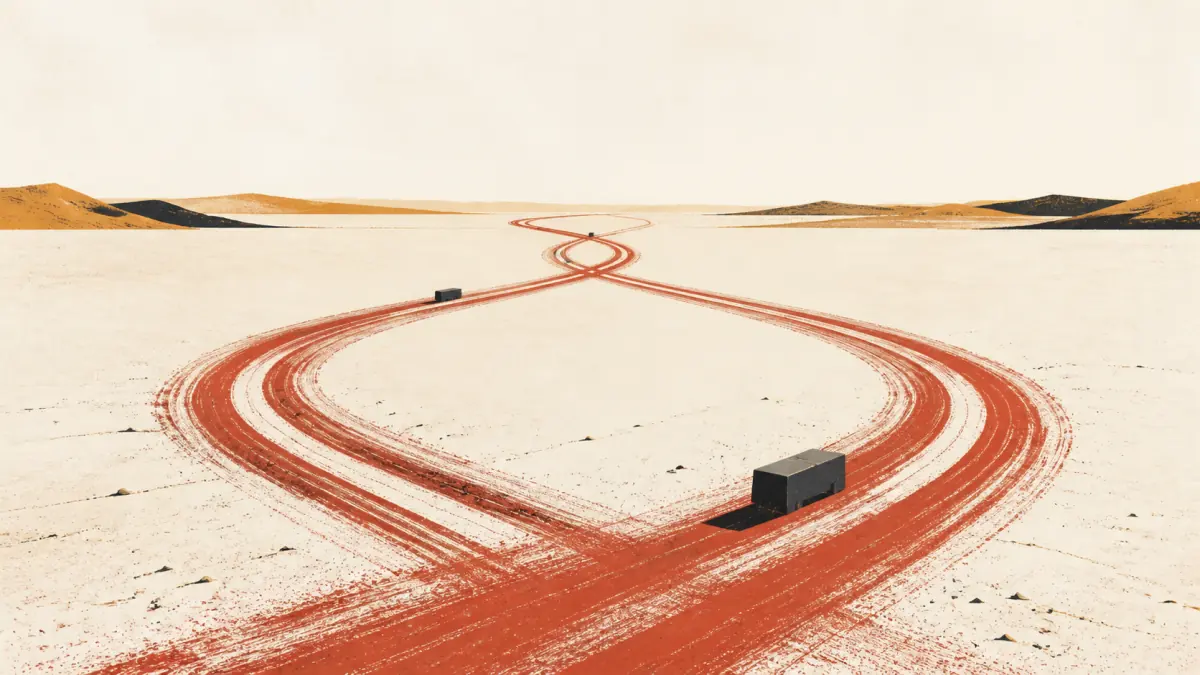
The plot of Mad Max: Fury Road can be reduced to an instruction a navigation app might give: drive away from the fortress, discover that the destination is gone, and turn around. Measured by the number of major events, George Miller’s 2015 film can look almost comically spare. It stages one pursuit across the desert and then sends its surviving pieces back along the same road.
Yet the return is not a replay. The outward journey is an escape from ownership. The drive back is a decision to contest the system that made escape necessary. Geography repeats while political meaning changes.
That distinction is the engine of this review. Miller uses center-weighted framing, exact editing, and physically credible motion to make a minimal out-and-back chase carry a revolution about women reclaiming their bodies, their direction, and a public resource. Some supporting characters and some of the film’s politics are compressed into instantly readable symbols, however, so the rating lands at 9.5 out of 10.
The argument is not that an action film secretly has depth once a critic decorates it with themes. The thought is already embedded in the action. Who holds the steering wheel? Who chooses when to turn? Whose body is treated as equipment? Where is the viewer asked to look? Who opens the water supply at the end? Fury Road answers political questions with spatial verbs.
A turn of the wheel can be a declaration
Furiosa begins the film with a rank, a machine, a route, and enough institutional trust to pass through the gate. Her revolt does not begin with a speech. It begins when the War Rig leaves its assigned path.
That deviation is more than efficient plotting. The regime depends on circulation: fuel, water, weapons, milk, bodies, and belief all move along channels controlled from above. Furiosa uses the authority she acquired inside that system to interrupt one of its routes. A turn of the wheel converts logistical expertise into disobedience.
The women she carries are not simply cargo under kinder management. They close doors, pass equipment, watch one another, insist on moral limits, and make consequential mistakes. The film allows fear and inexperience to remain visible; freedom does not download combat proficiency into everybody the instant a lock opens. What changes first is the right to choose. A transported object goes wherever the vehicle takes it. A character affects where the vehicle goes next.
The Green Place therefore matters most when it fails them. Had the refuge survived, the film’s politics could have ended at rescue: good people reach good land and leave everybody else beneath the Citadel. The dead landscape removes that clean exit. Furiosa has to accept that memory is not a destination and that purity cannot be found just beyond the next dune.
Turning back enlarges the mission. The group stops searching for a private outside and moves against the place that organizes scarcity. The same road that carried a small number of bodies away becomes a route toward the water, crops, and defensible infrastructure on which thousands depend. The map is unchanged. The definition of liberation is not.
The viewer’s eye is part of the stunt team
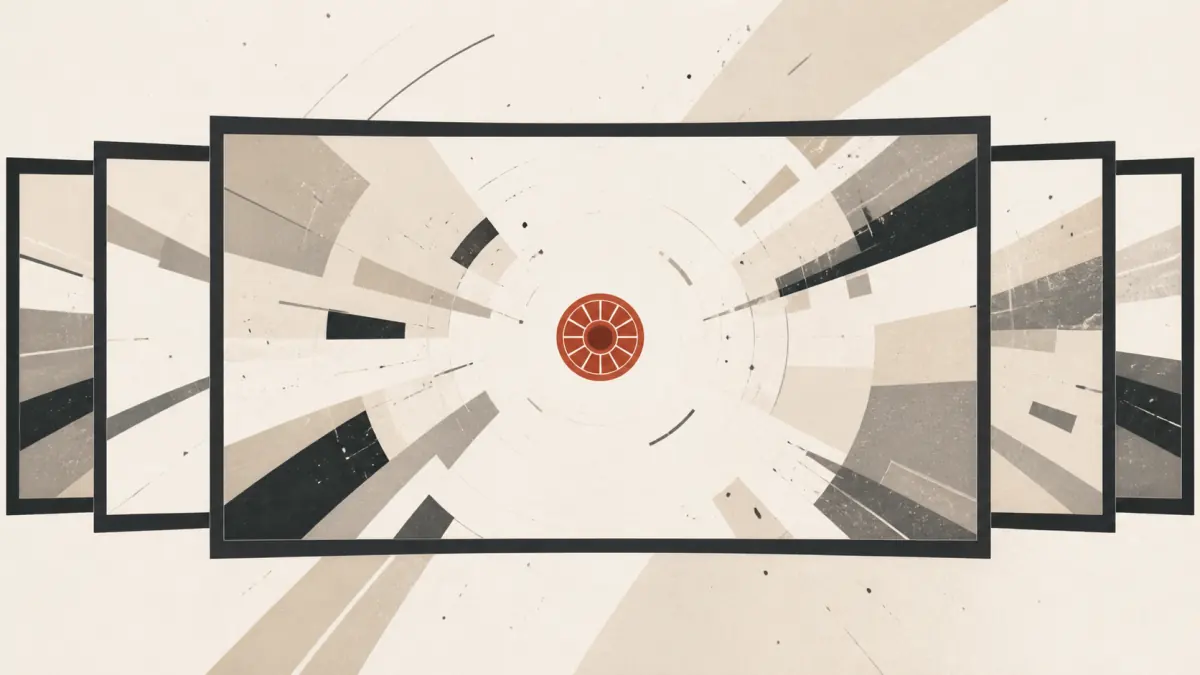
Fast cutting often gets confused with speed. Plenty of action films shake the camera, shorten the shot, and increase the volume, then ask confusion to stand in for intensity. Fury Road cuts quickly while preserving an unusually firm sense of distance, direction, and cause.
That clarity was designed before the edit. Cinematographer John Seale recalled that Miller required camera operators to keep each shot’s point of interest in the center of the frame. The goal was to send the eye directly from one important detail to the next instead of forcing it to search after every cut. Seale describes that process in detail in British Cinematographer’s production interview.
Centering sounds like the safest possible composition, but Miller turns it into an aggressive tool. The center holds a face, a wheel, a weapon, or a point of contact. The edges remain available for threat: another machine arrives, a body swings through space, or a plume of dust predicts the direction of impact. At the cut, the central object can retain nearly the same screen position even as scale, background, and velocity change completely.
The eye does not have to commute across the screen, so the brain can process more information at speed. That is why the film can be both rapid and dense without becoming a test of visual endurance. The edit supplies a stable handhold, while the rest of the image changes around it.
This technique provides concrete evidence for the claim that a simple plot can support rich storytelling. Individual shots often perform several jobs at once. They update the convoy’s location, redefine a relationship, introduce an object’s practical use, plant a future hazard, and deliver a joke. A chain, pole, engine, patch of mud, or piece of terrain may first appear as texture and later become the difference between survival and death. The film rarely pauses to explain its world because the image has already made a promise that a later action will collect.
Margaret Sixel won the Academy Award for editing the film. The Academy’s official record of the 88th ceremony lists ten nominations and six wins for Fury Road, including editing, sound editing, sound mixing, costume design, makeup and hairstyling, and production design. Awards are not proof of artistic value by themselves. In this case, though, the distribution is revealing: the film’s momentum is not being imposed by editing upon inert material. Costumes, machines, bodies, sound cues, and environments all deliver legible information into the cut.
In her BAFTA editing acceptance speech, Sixel described the project as an editor’s dream and connected it to Miller’s passion for cinematic language, especially the language of action. Her credit matters not merely because she found the shortest route through a mountain of footage. The finished film makes duration elastic. A fraction of a second can reveal a decision, while a sudden pause can make an injury feel longer than an entire chase.
Weight turns choreography into consequence
Practical stunt work is often praised as if the mere destruction of a real vehicle were an ethical achievement. What matters here is not a behind-the-scenes scoreboard of practical versus digital effects. It is the way physical resistance structures the drama.
At an American Film Institute seminar, Miller discussed his preference for filming vehicles, dust, and tumbles under real physical conditions. The future setting, he argued, did not require the motion to abandon the laws of physics. The AFI account of that conversation also records his description of the film as an extended chase conceived with the priorities of a silent movie, despite its enormous soundscape.
This should not be misread as a claim that Fury Road contains no digital work. Seale’s interview openly discusses reframing, color design, sky replacement, and extensive manipulation in post-production. The persuasive result comes from collaboration between captured motion and digital construction. The image can be heightened because it begins with gravity, dust, inertia, and light acting upon real surfaces.
When a tire bites into sand, a heavy chassis leans, or a person reaches between vehicles traveling at speed, the audience performs an involuntary risk calculation. Bodies cannot float harmlessly through the scene. Momentum has to be redirected or endured. Every transfer between machines therefore turns trust into something measurable.
That physical problem gives the film’s alliances their emotional force. Cooperation is not a slogan announced between set pieces. One person drives while another repairs. One holds a door, another watches the blind side, another provides the information needed for the next turn. Max’s blood begins as a resource extracted from him. By the end, giving it becomes a decision. The material action changes because consent changes.
Sound makes the weight even more precise. Engines do not form one continuous wall of noise; they cough, strain, miss, catch, and settle into different rhythms. Metal has distinct pitches. Drums and distorted guitar push the convoy forward, but short vacuums of sound can suddenly relocate us inside a wounded body. The mix tells us whether a threat is approaching, attached, or falling away before the image completes the information.
The spectacle is therefore readable with the whole body. It is not simply large. It has surfaces, resistance, and distances that the ear and eye can estimate.
Feminism is a question of infrastructure
The weakest reason to call Fury Road feminist is that it contains women who are good at fighting. A capable woman can serve an exploitative order as efficiently as any man. Furiosa is politically meaningful because her skill changes allegiance, and because the film’s idea of oppression extends beyond one villain’s personality.
The Citadel sorts bodies by use. Reproductive capacity is owned. Milk becomes a commodity. Water is withheld to manufacture obedience. Sick young men are taught to spend their shortened lives as fuel for a mythology that benefits the ruler. Women bear the most explicit violence, but the same order converts almost everybody beneath its summit into equipment.
Furiosa initially attempts a limited extraction. She uses the machinery and authority she possesses to take a few people beyond the system’s reach. When the Green Place proves impossible to recover, she does not discover a purer patch of desert. She changes the target from refuge to infrastructure.
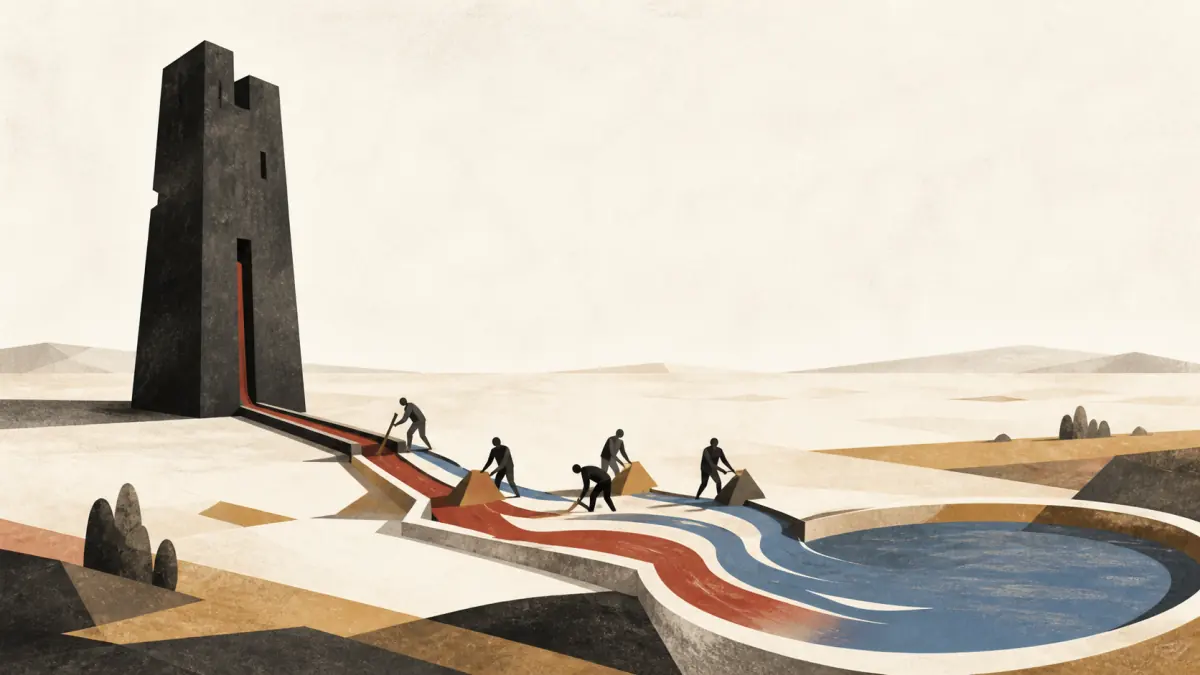
That change is why the release of water at the end carries more meaning than the death of Immortan Joe. Killing a tyrant completes a revenge plot. Opening the resource he monopolized begins a different relation between the Citadel and the people below. The film stops before that relation can become policy, but it gives the revolution a material first sentence: water moves down rather than power merely looking down.
Max is essential to the return without repossessing the film. He proposes a route, fights, drives, repairs, and gives blood, then disappears into the crowd. His usefulness is not diminished; ownership is. The film permits a male hero to affect the result without making the result his prize.
That is a more interesting revision of action masculinity than simply proving Furiosa can perform the same violence. Max’s first condition is extreme objectification: he is literally attached to another man as a blood supply. His movement toward agency does not end with control over everybody else. It ends with chosen interdependence. He can support Furiosa’s survival and recognize her leadership without requiring romance, gratitude, or the final platform.
The film’s symbols are powerful because they are compressed—and limited for the same reason
A 9.5 is not a request to let adrenaline answer every objection. Fury Road is brilliant at making a person readable through costume, posture, and one decisive action. That economy can also reduce a life to an emblem.
The escaped women respond differently to danger and freedom, but some receive only enough interior space to define a position within the group. The Vuvalini bring history, ecological knowledge, and an alternative social memory; the pace quickly feeds several of them back into sacrifice. In a film arguing that women are not interchangeable resources, certain deaths are still absorbed by the forward machine with uncomfortable efficiency.
The ending compresses political transition even more aggressively. Joe is exposed, Furiosa rises, the crowd recognizes her, and the water gates open. Emotionally, the sequence is exact. Politically, it remains an icon rather than an account. Who controls the food, weapons, and water tomorrow? How do people trained as subjects become participants in shared decisions? What prevents a new hierarchy from forming on the same platform?
The film is not required to become a municipal-governance drama in its final minutes. Ending at the revolution’s strongest image is a legitimate choice. It does mean, however, that Fury Road imagines overthrow in greater detail than stewardship. Its feminism is most convincing when it maps possession onto bodies and infrastructure; it is least complete when victory appears to solve the difficult distance between access and collective rule.
There is a formal version of this limitation too. Centered eye trace and constant propulsion can feel programmatic. Nearly every minute demonstrates that Miller knows where the viewer should look. Even quiet scenes carry pressure from the next ignition. For some viewers, clarity will not prevent fatigue. Two hours of beautifully organized intensity can still flatten into one sensory register.
That response should not be dismissed as a failure to understand action cinema. The film designs pauses as components within propulsion rather than as genuinely open time. Its purity is thrilling, but purity always excludes something.
A simple story is not a small story
The phrase “simple plot” often mistakes event count for narrative capacity. Fury Road contains few large turns, but nearly every look, object, noise, and vector accumulates meaning. Center-weighted framing lets fast cuts remain readable. Physical weight makes cooperation costly. The return journey converts private rescue into a struggle over a common resource. Form, character, and politics do not sit in separate departments; they mesh like parts of one engine.
The missing half-point acknowledges what that engine consumes. More time in which supporting characters were not defined by immediate function would deepen the film’s claim that bodies exceed their assigned uses. More attention to the distance between seizing a resource and governing it together would make the final revolution harder to reduce to a transfer of heroes.
Those reservations do not weaken the central achievement. They arise because the film creates political and cinematic questions larger than one chase can settle safely. It provides an image of liberation strong enough to invite an argument about what happens after the gate opens.
So the rating is 9.5 out of 10. This is a film whose causal structure remains legible without subtitles and whose design can survive shot-by-shot analysis without exhausting its ideas. It takes the straightest possible road to prove that narrative depth does not require plot detours. Then it uses one turn to make a final distinction: freedom is not only the ability to leave a bad place. It is the decision to return and change who gets the water, who sets the direction, and who occupies the center of the story.
Sources checked
- The 88th Academy Awards: ten nominations, six wins, and the official category record
- American Film Institute: George Miller on the extended chase, silent-film priorities, and physical effects
- British Cinematographer: John Seale on center-weighted framing, camera practice, and post-production
- BAFTA: Margaret Sixel’s editing acceptance speech