Arrival (2016): The Nonlinear Cut Is the Argument, Not the Trick
Arrival (2016)
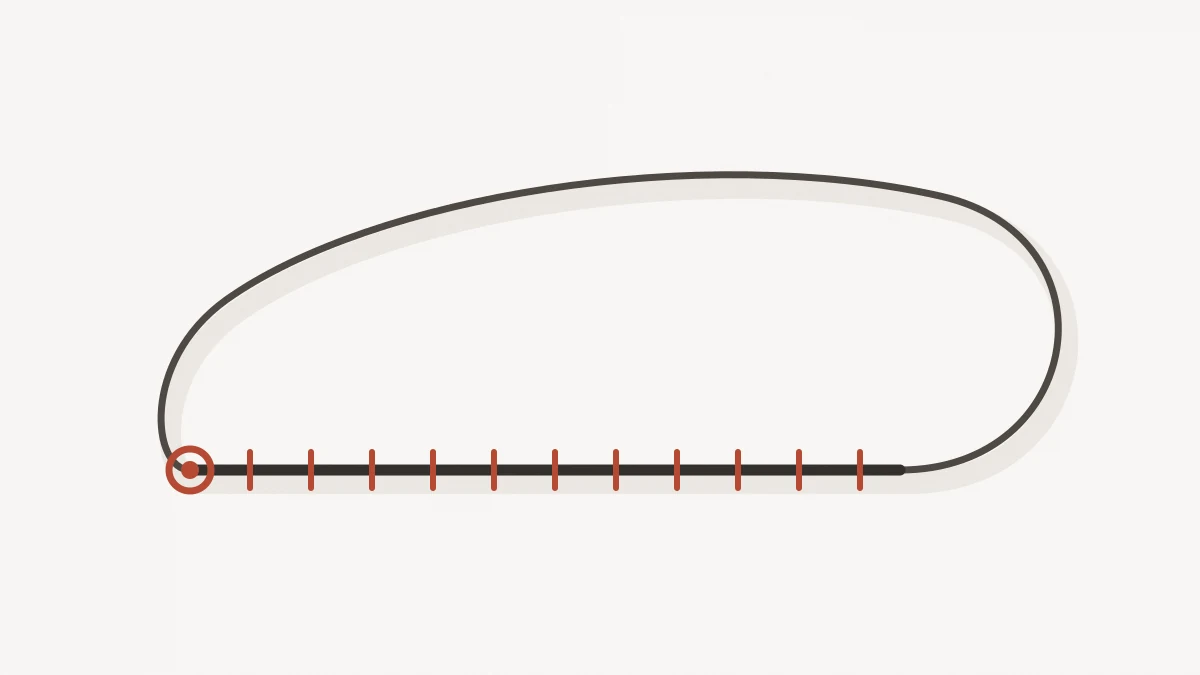
Run a thought experiment before defending anything about Arrival. Take Denis Villeneuve’s 2016 film and put its events in chronological order. Louise Banks decodes an alien script, learns to think in circular sentences, gains the ability to perceive her own future, sees that she will have a daughter who dies young, and has the child regardless. Same scenes, same dialogue, same outcome.
That version is a story about acceptance. We watch a woman absorb a verdict. The film we actually got is doing something else, and the difference is entirely a matter of where the cuts fall.
The claim of this review: Villeneuve makes nonlinear editing carry an argument rather than a suspense mechanism — “knowing how it ends and choosing it anyway” only becomes a real proposition once the audience has misread foreknowledge as memory and then been made to turn it right side up themselves. The mechanism that grants Louise that foresight leans on a version of the Sapir-Whorf hypothesis that linguists have rejected, and the global storyline resolves far too cheaply, so this site rates it 9.0 out of 10.
None of this is depth applied to a genre film after the fact. The adaptation began with structure. Screenwriter Eric Heisserer, writing about the process, describes having “mapped out the nonlinear narrative” before he saw how much room there was to expand Ted Chiang’s ideas. The source novella, “Story of Your Life,” won the Nebula Award for Best Novella in 1999 according to SFWA’s own award record, and it won on exactly this ground: grammar deciding how a narrator can tell her own life.
The three minutes at the front are not a prologue
The film opens on roughly three minutes of a daughter — born, growing, ill, gone — and then a linguist walking into a nearly empty lecture hall. Audiences read this as backstory, and not because they are careless. The sequence deploys every convention English-language cinema uses to mark the past tense. The light is warm, the focus soft, the score strings rather than synthesizers. The voiceover has the cadence of summary. It cuts directly to a woman living alone.
No single one of those cues fixes a tense. Stacked together, they do the work automatically: she lost a child, and that loss explains who she is now. The film never lies. It simply declines to tell you when you are.
The outermost clue sits in the music. The pieces bracketing the film are not from Jóhann Jóhannsson’s score at all, but from Max Richter’s 2004 album The Blue Notebooks — the track “On the Nature of Daylight.” FACT reported that Richter was reluctant to license it, and that Villeneuve phoned to explain how integral the piece was to the architecture of the film: it starts and ends the picture. The last thing you hear is the first thing you heard. On a first viewing that reads as emotional symmetry. On a second it is a diagram.
Reorder the same scenes and the proposition changes
Return to the chronological cut. Nothing about the plot is lost in it. What is lost is the audience’s position.
In the linear version the viewer stands beside Louise while she receives information and submits to it. In the released version the viewer spends three minutes grieving, spends two hours reinterpreting that grief as something not yet lived, and arrives in the final act holding precisely what Louise holds. One version asks for sympathy toward a decision. The other hands the decision to the person in the seat.
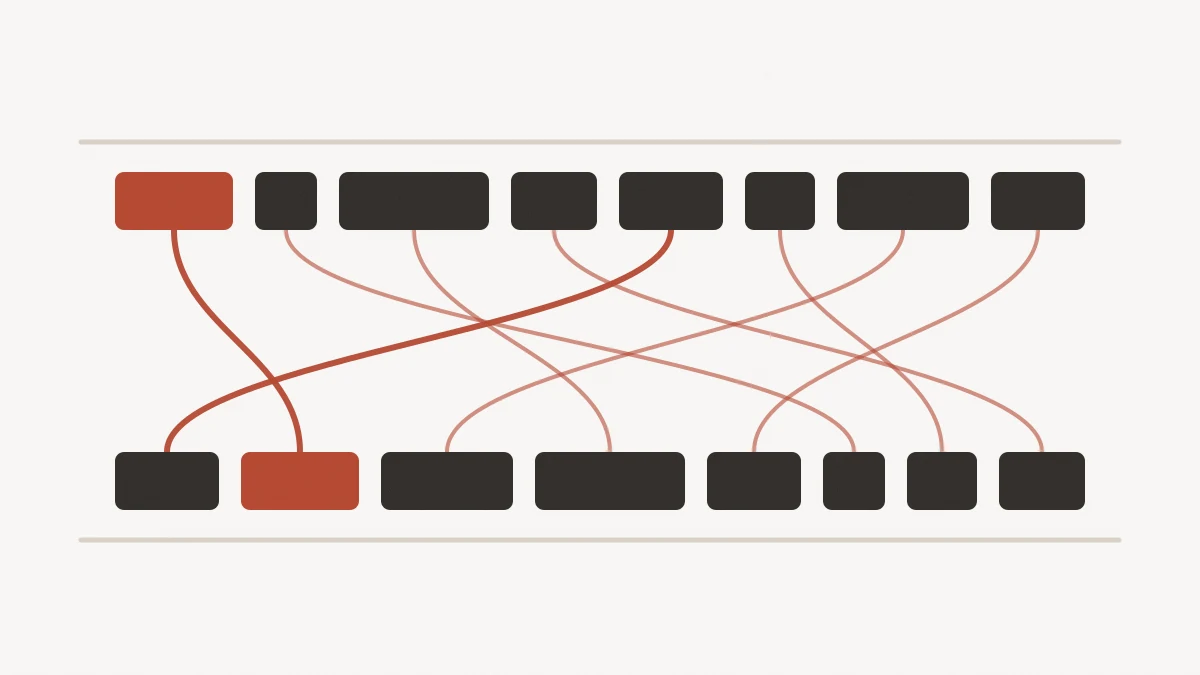
This is also why the film cannot ask its central question early. “If you could see your whole life, would you change it?” is a seminar prompt in the first act. Delivered after the audience has spent an entire feature investing in a relationship it believed was over, the same words carry weight, because the investment turns out to have been in something that has not happened yet. The editing is not withholding information to produce surprise. It gets you to invest, then changes what you invested in.
Heisserer notes that he and Villeneuve identified the minimum set of steps in Louise’s personal journey and treated it as the hill they would die defending. The finished film shows that priority plainly. The alien ship’s internal rules, the military procedure, the technical business of decipherment are all trimmed to the least that will function. The daughter material is left intact, because it is the only strand living in two tenses at once, and the only one capable of bearing the reversal.
Circles are the grammar, not the costume
A heptapod sentence is a closed ring, emitted at once, with no part written before any other part. That is a seductive idea on paper and a difficult one on screen, where the writing has to look alien and remain readable. Production designer Patrice Vermette told Global News that the aesthetic came from the artist Martine Bertrand, whose ink blots “at first could be anything,” and that he and graphic designer Aaron Morrison then assigned meanings and built a dictionary capable of generating more words.
The sequencing matters. Vermette says they built the language first and only afterward brought in a linguist and a mathematician for credibility — “they weren’t part of the creation of the language.” That explains why the logograms resemble no human writing system. They were not derived from hieroglyphs or ciphers; they grew out of a visual instinct and had rules reverse-engineered onto them.
The film’s real cleverness is turning that shape into a rule for watching. If a heptapod sentence has no first stroke and no last, a film about learning that language has no obligation to run left to right either. Louise’s daughter has a name that reads identically in both directions. The film never stops to point this out, but it is consistent with everything else in the design: enter from either end, arrive at the same place. Form here is not decoration on content. It is a restatement of it.
Voices, not synthesizers
Jóhannsson’s score gets described as the unnerving low-end one, which misses the actual decision. Speaking to SlashFilm, he explained that the score contains a great deal of vocal music — choir and solo, using extended techniques including throat singing and harmonic singing — and that the choice was “motivated by the script and the story. It’s a story about communication. It’s a story about language.” He also framed the work as an exercise in avoidance: there were more things to stay away from than to reach for, because science fiction has a stockpile of overused sounds.
That choice runs parallel to the images. Build an alien signal out of synthesis and the audience hears technology. Build it out of human throats producing sounds humans do not usually make, and the audience hears a body attempting speech. The difficulty of communication stops being an abstraction about translation and becomes a physical fact the ear can test: different organs, different resonating chambers, pauses landing in the wrong places. The low frequencies unsettle not because they are loud but because they sound like they came from anatomy.
Taking the “it’s just a twist” objection seriously
The standard case against this film is that it disguises the future as the past, flips the card, and works exactly once — a Sixth Sense structure with better lighting. That deserves an answer rather than a shrug.
A twist has a testable profile: information is concealed, the reveal produces surprise, and the earlier material is demoted to clue-hunting afterward. Apply that test here and the result inverts. First, the earlier scenes do not depreciate on rewatch; they gain. What played as “she lost a child” plays the second time as “she already knew she would, and stayed anyway.” That is accumulation, not recycling.
Second, the film is not guarding its secret. The clues sit in plain view. In the domestic scenes, the daughter asks her mother for a particular term — one Louise only picks up from Ian during the mission itself, which quietly dates those scenes for anyone listening. Later she recites a dying woman’s last words to a general she has never dealt with privately. A film built on concealment has to seal its leaks; this one scatters them.
Third, and decisively, the story continues after the reversal. For the last stretch the audience and Louise hold identical information — the child will be born, will get sick, will die — and the film stages her choice inside that equality. A twist film ends at the reveal, because the reveal was the point. This one keeps going, because putting you in the position of already knowing was the point.
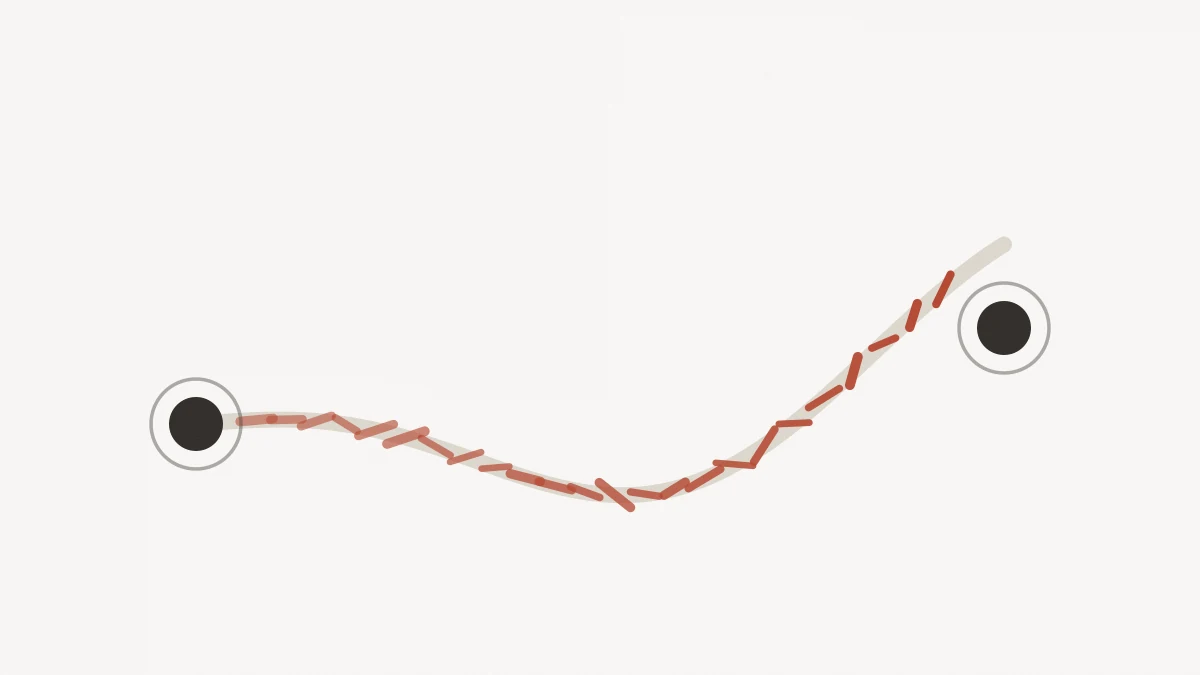
It makes a useful pair with Eternal Sunshine of the Spotless Mind, which runs its erasure backwards so its characters can work out what they want to keep while losing it. Arrival hands over the ending in advance and asks whether you would begin at all. Neither film depends on being unguessable. Both use structure to move an abstract proposition into a seat the viewer has to occupy.
Where it slips, one: naming the hypothesis out loud
The mechanism is explicit. Learning heptapod rewires how its user experiences time, and the film reaches for the Sapir-Whorf hypothesis to license this. Jessica Coon, the McGill linguist who consulted on the production, is blunt about that idea in her Sloan Science & Film piece: applied among human languages it has been shown to be “not only wrong, but dangerous.” She grants the film its exit as well — where non-human language is concerned, “all bets are off.”
The problem is not invented physics; science fiction is allowed new rules. The problem is that the film has a character say the hypothesis by name, as explanation. Once the term is spoken in dialogue it stops being this film’s premise and starts sounding like established knowledge, and the audience is invited to believe there is a literature behind it. For a production this careful about credibility elsewhere, that is self-inflicted. Vermette went looking for experts to vouch for a font; the screenplay conscripted a discredited hypothesis to justify its plot engine.
The waste is that the scene does not need it. Keep the phenomenon — she learns another way of thinking, and time stops being a line for her — and drop the terminology. The metaphor gets cleaner and the film stops endorsing a misreading.
Where it slips, two: twelve ships, one phone call
The second failure is one of scale. Considerable effort goes into establishing a genuinely global situation: twelve landing sites, governments drifting apart, intelligence-sharing collapsing, panic buying and unrest on the news feeds. Thematically this belongs to the main line exactly — humans cannot translate each other either.
The resolution arrives far too fast. A planetary standoff dissolves through a private phrase Louise obtains from the future and delivers by phone. Emotionally it lands, because it reduces an enormous political problem to one sentence between two people. As argument it is the only place in the film where coincidence substitutes for reasoning. Two hours establish that understanding takes time, error, and repetition; then the hardest act of cross-cultural communication in the story completes in under a minute, using a bonus faculty rather than anything either side learned.
The other eleven sites suffer the same compression. The film states that the heptapods split their message into twelve parts precisely to force cooperation — one of its best ideas, and almost entirely unstaged. What we see of cooperation is a screen of connections blinking on, not a single costly, difficult negotiation. A film arguing that communication is hard treats the human half of communication far more lightly than the alien half.
9.0: tightly argued, with a world smaller than its heart
The achievement here is interlock. The editing is not a stylistic preference; remove it and the proposition changes. The circular script is not a design flourish; the circle is the reading rule for the whole film. The vocal score is not atmosphere; it is the sound of a body trying to speak. That degree of dependency between form and claim is rare in science fiction, where the two more often merely coexist.
The missing point sits in two specific places. One is the theoretical scaffolding built under the foresight, which chains an elegant metaphor to a hypothesis the field has discarded, and which the drama could have skipped entirely. The other is the imagination extended to the human world, which is visibly thinner than the imagination extended to first contact: twelve sites, twelve fragments, a puzzle requiring cooperation, settled by a phone call. The objection is not that this is insufficiently entertaining. It is that the film set the standard and then failed to hold itself to it.
So the rating is 9.0. That number means: worth a deliberate second viewing, and the second one is better — not because the puzzle finally resolves, but because every scene you filed under memory becomes evidence of a woman who knew the ending and stayed in the room. It falls short of the top because when the camera turns from that woman toward the rest of the planet, its patience noticeably thins.
Sources checked
- SFWA’s official Nebula record: Ted Chiang’s “Story of Your Life” wins Best Novella for 1999
- Sloan Science & Film: the film’s linguistics consultant Jessica Coon on Sapir-Whorf and heptapod language
- Talkhouse: screenwriter Eric Heisserer on writing Arrival and mapping its nonlinear narrative
- SlashFilm: composer Jóhann Jóhannsson on scoring first contact with voices and extended technique
- FACT: Max Richter on “On the Nature of Daylight” and Villeneuve’s request
- Global News: production designer Patrice Vermette on the circular ink language and its dictionary