Spirited Away (2001): Not a Fairy Tale, but a Film About Asking for a Job
千と千尋の神隠し (2001)

Before Spirited Away was a film, it was a two-page pitch. Miyazaki wrote it to persuade his own studio, and one sentence in it explains the entire movie better than any of the thousands of essays written since:
In turn, if Chihiro says “I will work here,” even the witch cannot ignore her.
The sentence before it is the other half of the rule. If Chihiro says “no,” or “I want to go home,” Yubaba throws her out, and she wanders until she fades — or gets turned into a hen that lays eggs until something eats her.
Put those two together and you have the physics of this world. Asking for a job is not a plucky character beat here. It is the only sentence that stops you from being eaten.
That is why I don’t think this is a fantasy about a girl finding her courage. It is a film about labour — specifically, about work as the price of admission to existing at all. Everything the film is loved for, the soot sprites, the sea train, No-Face, sits on top of that one transaction.
Yubaba isn’t a witch. She’s middle management.
If you read Yubaba as a villain, the film collapses into a fairy tale. Miyazaki didn’t read her that way. Talking to Animage in May 2001, while the film was still being finished, he described his own story like this:
I think this story is similar to that of a girl who comes to, for example, Ghibli, and says, “Let me work here.” (…) Joining an organization, finding your own place, and being recognized there requires a lot of effort. (…) But that’s a matter of course, that’s living in the world. (…) The scary woman, Yu-baaba, who looks like a bad guy in this film, is actually the manager of the bath house where the heroine works.
Once you accept the word manager, the staging clicks into place. The bathhouse isn’t a labyrinth, it’s a company with an org chart: an owner, two floor supervisors, a front desk, frog-shaped junior staff working the floor, a boiler room nobody wants to be posted to but which cannot be switched off, and soot sprites doing the work nobody bothers to name.
Chihiro’s route through it is a job hunt with every step intact. She finds the one insider who will talk to her, Kamaji in the boiler room. He turns her down — she isn’t his apprentice, and he says so. She gets directed to the only person with the authority to hire. The interview is hostile. She is made to sign. Then she is onboarded, assigned to the least desirable shift, and starts at the bottom, scrubbing tubs alongside Lin.
That is not the rhythm of a fantasy adventure. That is the rhythm of getting hired. Miyazaki dropped a ten-year-old into a workplace, not a wonderland — and he did it on purpose, because he wanted a heroine ordinary girls could recognise rather than one they could only admire.
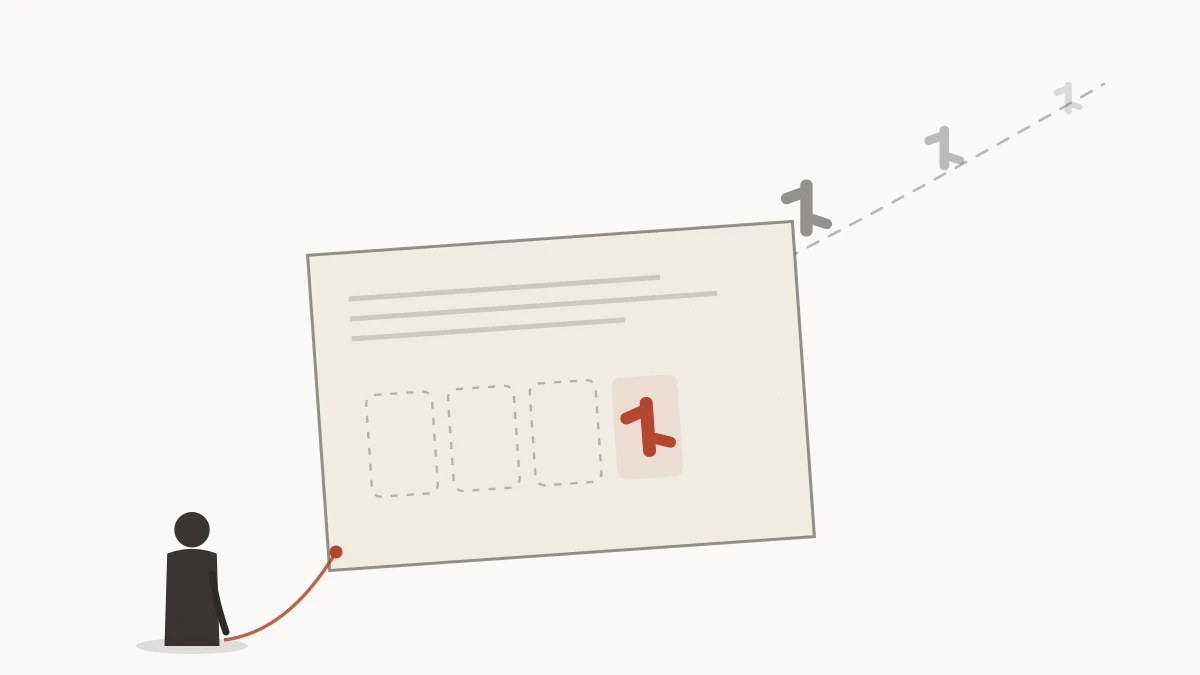
The contract that saves her is the contract that eats her
The pitch document is equally blunt about the other side of the deal:
The act of depriving (a person) of one’s name is not just changing how one (person) calls the other. It is a way to rule the other (person) completely.
Chihiro signs, Yubaba’s fingers close, and three of the four characters in her name are lifted off the page. What’s left is “Sen.” She has bought the right to remain, and the currency was herself. This is the film’s sharpest single image of employment: the entry ticket and the leash are the same piece of paper.
Haku is where that line ends up. He wasn’t dragged here; he came voluntarily, to learn magic, and he can no longer remember what he was called. In workplace terms he isn’t a victim, he’s a senior employee — long-tenured, competent, trusted with the jobs the boss doesn’t want her own hands on, and hollowed out by exactly those qualifications.
Note carefully how he is saved. Not by work. Chihiro rescues him by remembering the river she fell into as a small child, and remembering its name. The film’s first serious argument with its own premise arrives right there: labour can buy you survival, but the thing that gives you back to yourself always comes from outside the job.
The failure of that mentorship is a mirror image of the one we wrote about in Spider-Man: Homecoming. There, the mentor takes the responsibility and holds it for the kid. Here, the mentor takes the name and holds it for the employee. Opposite gestures, identical result: whoever gets held takes years to find their way back.
The stink god is the only time the film shows work being done properly
If I had to defend the “this is a labour film” reading with a single scene, it would be the stink god.
A reeking customer walks in, the entire staff scatters, and the first thing management does is assign the client nobody wants to the most junior person on the payroll — the one with no standing to refuse. Chihiro is not handed a trial. She is handed a bad shift.
And what she does with it is work, step by step, rather than heroism. She observes: something is protruding from the customer. She judges: that isn’t decoration, it’s a thorn. She asks for help: she can’t pull it alone, so she calls out. Then the whole bathhouse hauls on one rope, and out comes a bicycle, followed by an entire landfill’s worth of what people have thrown into a river.
It was never a stink god. It was a river god, choked with garbage.
That scene is the hinge of the film because of what it pays out. The god leaves behind a mound of gold and one bitter dumpling. That dumpling is what later makes Haku vomit up Yubaba’s stolen seal and the parasite inside him, and what makes No-Face bring up everything he has swallowed. Every victory Chihiro has in the back half of the film is her cashing in the one shift she did properly. The film doesn’t make her stronger for it — it gives her something to use. Those are different claims, and the second one is far more honest than the first.
And note what she leaves on the floor: all of the gold.
No-Face is the control experiment. He watches, and what he learns is the bathhouse’s other rule — hold out gold and everyone comes running. Within three minutes of him producing it, the entire workforce’s labour has curdled into scrambling, flattery, and being swallowed. Chihiro is the only one who says no to the gold, which is precisely why she’s the only one he can’t consume.
The film says you must work in order to exist, and in the same breath says that working for money will turn you into a mouth. Its attitude to labour was never celebratory. It is a description of a situation with no exit.

The objection, and it comes from Miyazaki
Honesty requires dealing with the obvious counter-argument: isn’t “girl grows up by doing her job well” just a film being squeezed into a convenient inspirational shape?
Yes — and the evidence against it comes from the director. From the same Animage interview:
it’s not a story in which the characters grow up, but a story in which they draw on something already inside them, brought out by the particular circumstances
The pitch document says the same thing in different words: when reality becomes clear and she finds herself in crisis, her adaptability and endurance “well up” within her. Well up. Not develop, not get earned.
This doesn’t sink the labour reading. It sinks the cheap version of it. And the film backs Miyazaki up: Chihiro never has a training montage, never learns a spell, never acquires a skill. She gets no upgrade at all. The only thing that measurably changes is her face — the pitch predicts that the sullen, listless child will wear “a surprisingly attractive expression” by the end, and she does.
So the corrected claim is this: work doesn’t transform Chihiro. Work buys her the time and the standing for what was already in her to surface. It’s a less quotable sentence than “hard work makes you brave,” and it is the one the film actually dramatises.
A darker reading, and why it strengthens the case
There is one more interpretation that deserves a straight answer rather than a shudder. The Japanese word yuna — the historical term for a woman working in a bathhouse — is not a neutral job title. Nihon Dai-Hyakka Zensho defines it as a woman who attended bathers at hot springs and bathhouses, “some of whom became unlicensed prostitutes”; the Britannica Japanese concise edition simply calls the yuna a kind of prostitute employed by bathhouses. The critic Tomohiro Machiyama built a well-known argument on this in 2004, and quoted a Miyazaki interview in the Japanese edition of Premiere (21 June 2001) in which the director said that if you want to depict today’s world, the sex industry is the most fitting subject, because Japan has become a society that is like the sex industry all the way through. (I could not open that interview at source, so I flag it as second-hand and don’t rest any argument on it.)
I don’t think the reading needs to be taken all the way. There is nothing sexual on screen, and forcing the bathhouse into a brothel throws the river god, the soot sprites and No-Face out of focus.
But it does insist on something the sentimental readings skip: the film never pretends this is a good employer. The bathhouse takes names, rations dignity by rank, grovels at customers, and loses its collective mind at the sight of gold. Chihiro is not growing up inside a healthy workplace. She is buying temporary residency in a place that eats people.
Far from refuting the core judgement, that tightens it. Labour in this film is a survival mechanism, not a virtue.
Why it doesn’t score higher
Spirited Away hits its ceiling in its last half hour.
The sea train is one of the most beautiful sequences in animated film — one-way service, no return leg, translucent passengers, No-Face sitting quietly for the first time. But look at what it does structurally: it swaps the solution from work to travel. At Zeniba’s cottage, the problem is resolved by spinning thread together and by a line of dialogue — your boy and your bird went home on their own. It is lovely. It is also not something Chihiro earned.
Yubaba’s final test makes the slack visible. Pick your parents out of a pen of pigs. Chihiro looks and says none of these is my mother or father, and she’s right. But the film has given the audience nothing to judge alongside her: the pigs are undifferentiated, and nothing earlier taught her — or us — how to tell. It’s the one moment in the film where the protagonist wins on unearned intuition.
Set that next to the river god sequence — observe, judge, ask for help, execute, no step skipped — and the drop-off is obvious. The first is the best thing in the film. The second is the loosest.
That gap is why this lands at 9.2 rather than the 9.5 we gave The Lord of the Rings. That trilogy leaves the weight on its characters right to the end; Frodo is never let off. Spirited Away lifts the weight off in its final ten minutes and lets Chihiro through on a guess.
What 9.2 means
For the record: this review and its score come from this site’s editorial desk, and don’t stand in for anyone’s private viewing diary.
9.2 says that the density of the world-building, the honesty about what work actually costs, and the nerve required to tell an audience of ten-year-old girls that you have to be useful before you’re allowed to exist, are all far beyond what animation usually attempts. The missing 0.8 is entirely the exit ramp the film builds for Chihiro, which is gentler than anything else in it.
It isn’t a fairy tale. It’s a film that gets the experience of having a job more right than most workplace dramas do — except the protagonist is ten, and the company eats people.
Sources
- Spirited Away official film page — Studio Ghibli (released 20 July 2001; original story, screenplay and direction by Hayao Miyazaki; running time approx. 125 minutes; distributed by Toho)
- Miyazaki’s pitch document, “The Purpose of the Film,” English translation — Nausicaa.net / Team Ghiblink (original published on Toho’s official site; the “I will work here” and name-stealing passages)
- Miyazaki interview, Animage, May 2001, translated by Ryoko Toyama — Nausicaa.net (the Ghibli analogy, Yubaba as manager, “not a story in which the characters grow up”)
- 75th Academy Awards winners — Academy of Motion Picture Arts and Sciences (23 March 2003, Animated Feature Film)
- 2002 Berlinale prize winners — official festival archive (Golden Bear, awarded ex aequo with Bloody Sunday)
- Dictionary definitions of 湯女 (yuna) — kotobank, collecting Nihon Dai-Hyakka Zensho, Seisenban Nihon Kokugo Daijiten, Britannica International Encyclopaedia and others
- Tomohiro Machiyama, “Why is Spirited Away about yuna?” (14 March 2004) (quoting the Japanese Premiere interview of 21 June 2001)