Eternal Sunshine of the Spotless Mind (2004): Not a Romance — a Horror Film Where the Patient Screams and Nobody Hears
Eternal Sunshine of the Spotless Mind (2004)

Every February, some streaming service puts Eternal Sunshine of the Spotless Mind on a Valentine’s Day list.
The joke is that the film already knows. Its first scene takes place on Valentine’s Day — and what happens on that Valentine’s Day is that a man calls in sick with an invented case of food poisoning, takes a train in the wrong direction, and wanders an empty winter beach alone.
When he sits down and opens his journal, the screenplay’s stage direction is almost bored about what he finds: a great many pages have been torn out after the last entry. The last entry is dated January 2001. He writes a new one dated Valentine’s Day 2003, notes that it is his first entry in two years, and asks where those years went — concluding that if you’re not careful it gets away from you.
Nothing in the scene explains itself. On a first viewing it reads as ordinary middle-aged melancholy. Only once the film turns its timeline over do you learn that those two years did not “get away” from anyone — and that the pages were torn out by him.
Step one of the Lacuna procedure isn’t surgery. It’s a homework assignment. The doctor’s instruction arrives in voiceover with the cadence of an administrative form: collect every single thing you own that has any association with Clementine, anything — photos, clothing, gifts, journal entries — we want to empty your home, your life, of Clementine. So we watch Joel drag a black bin liner around his own apartment, dropping in books, perfume, a CD, her letters, the gift he never gave her, and tearing out of his own journals the pages that have her in them. He carries two full bags through the streets of New York and sits in the Lacuna waiting room next to a red-eyed woman holding a cardboard box of dog toys and dog bowls.
So the real content of that opening image is this: a man sits on a winter beach turning the pages of a journal he destroyed himself, with no memory of destroying it. The film gets classified as a romance, but its first scene is a crime scene where the only fingerprints belong to the victim.
Hold on to that, because it recurs: every decisive step in this procedure is one Joel performs on himself.
The film does to you exactly what Lacuna does to Joel
Almost everything I admire about this movie comes down to one decision: it does not depict memory loss. It gives you one.
Non-linear structure is not an achievement by itself. What makes this film’s use of it unusual is the specific experience it engineers. The opening stretch gives you a meeting with no context — a man so withdrawn he mumbles, a woman whose hair is dyed a blue she tells him is named after cheap gin, an inexplicably quick intimacy between two people with nothing obvious in common. You think you are watching act one of a love story.
Then the timeline turns over, and you learn that it was never act one. It was debris. That meeting felt arbitrary because its causes had been cut away. What you were watching and what Joel holds in his hands — a notebook with a great many pages missing — are the same object.
This is form doing the arguing. The film never has to state that erasing memory is monstrous. It puts you through an erasure while you are unaware, then walks you back and tells you what you just experienced. The dread arrives retroactively, which is precisely the shape of the thing itself: the horror of losing a memory isn’t the loss. It’s not knowing that anything is gone.
A real romance would not open this way. A romance opens by asking you to believe the meeting is fate. Eternal Sunshine opens so that, later, you will discover your sense of fate was the residue of a medical procedure.
The title is a confession, not a blessing
The phrase comes from Alexander Pope’s 1717 poem “Eloisa to Abelard.” This usually gets mentioned as trivia. Read the surrounding lines and it stops being trivia and becomes the film’s thesis statement.
Pope is writing the twelfth-century story of Héloïse and Abélard: she has been sent to a convent, and the man she loves can never answer her. In the order the 1717 edition prints them, the lines run like this.
Eloisa first looks enviously at the nun: how happy the blameless vestal’s lot, forgetting the world and forgotten by it, eternal sunshine of the spotless mind, every prayer accepted and every wish resigned. Then she keeps going, building that state into a paradise — labour and rest in equal measure, obedient slumbers, composed desires, tears that delight, grace shining around her, whispering angels, the unfading rose of Eden, heavenly harps — until the nun “melts in visions of eternal day.”
And then, directly beneath that long stretch of praise, she demolishes all of it. Her own erring soul, she admits, is occupied by far other dreams, far other raptures, of unholy joy.
The order is the point. This is not suffering followed by longing. It is a woman describing the blankness as heaven at length and then, immediately, conceding she cannot get there. The phrase was never a blessing; it is an aspiration its own speaker punctures on the spot.
Which is a miniature of what the film does to its audience: sell you the proposition first, then show you that the person making the pitch is already past saving.
The film understands this so precisely that it hands the poem to the one character who should not be reciting it. Mary, the receptionist at Lacuna, offers it to her boss, Dr Mierzwiak, as a pretty quotation, and gets the poet’s name backwards — calling him Pope Alexander.
What the audience learns later is that she has had the procedure herself, and that what was removed was her relationship with the man she was quoting to. His confession is startlingly light: they have a history, he’s sorry, she wanted the procedure, she wanted it done so she could get past it. The stage direction that follows is the part that lands — she stands there unable to digest it, struggling in vain to remember.

In the same scene she raises a glass to a second quotation — Nietzsche, on how the forgetful are blessed because they get the better even of their blunders — and then adds, unprompted, that she found it in her book of quotations.
That detail is crueller than any line of dialogue. A woman whose memory was taken is filling the hole with a reference book. She praises forgetting because forgetting was done to her; she borrows other people’s insights because her own were deleted. No character explains this. She just smiles and finishes the poem.
We wrote about a variant of this in Spirited Away, where Miyazaki’s own project proposal defines taking someone’s name as a way to rule them completely. Taking a memory is the more thorough version of the same move: someone stripped of their name at least knows they used to have one.
“Technically, the procedure itself is brain damage”
If I had to prove the film’s genre with a single line, it would be this one.
Joel sits in an examination chair with two blue dots drawn on his forehead and asks whether there is any risk of brain damage. The doctor answers that technically the procedure is brain damage — but on a par with a heavy night of drinking, and nothing he’ll miss.
The horror is not in the content. It is in the register. The exchange is written as routine pre-op patter, the tone a dentist uses about a root canal. A procedure whose practitioner concedes it causes brain damage is packaged as a weekend errand, and Joel simply nods.
Look at who performs it, too. This does not happen in an operating theatre. Two technicians carry equipment cases into your bedroom, hand you a pill, and let you go under on your own mattress in fresh pyjamas. One of those cases is packed with beer. When the receptionist arrives in the middle of the night and finds the beer inadequate, she helps herself to a bottle of the unconscious client’s scotch and two glasses, and she and one of the technicians drink and dance beside the bed.
The other technician is worse. Patrick admits that during the night he spent erasing Clementine, he developed a fixation on the woman lying in front of him, and stole a pair of her underwear. His colleague’s reply is the bluntest indictment in the film: she was unconscious, Patrick.
Line those details up and the real subject surfaces: this is not a film about a breakup. It is a film about handing the most private thing you own to people who should never have been trusted with it. Client unconscious, strangers inside the apartment, nobody supervising — the film has the full horror-movie apparatus. It simply plays the scene for laughs.
The scream nobody hears
And the most frightening scene in the film is staged as the romantic climax.
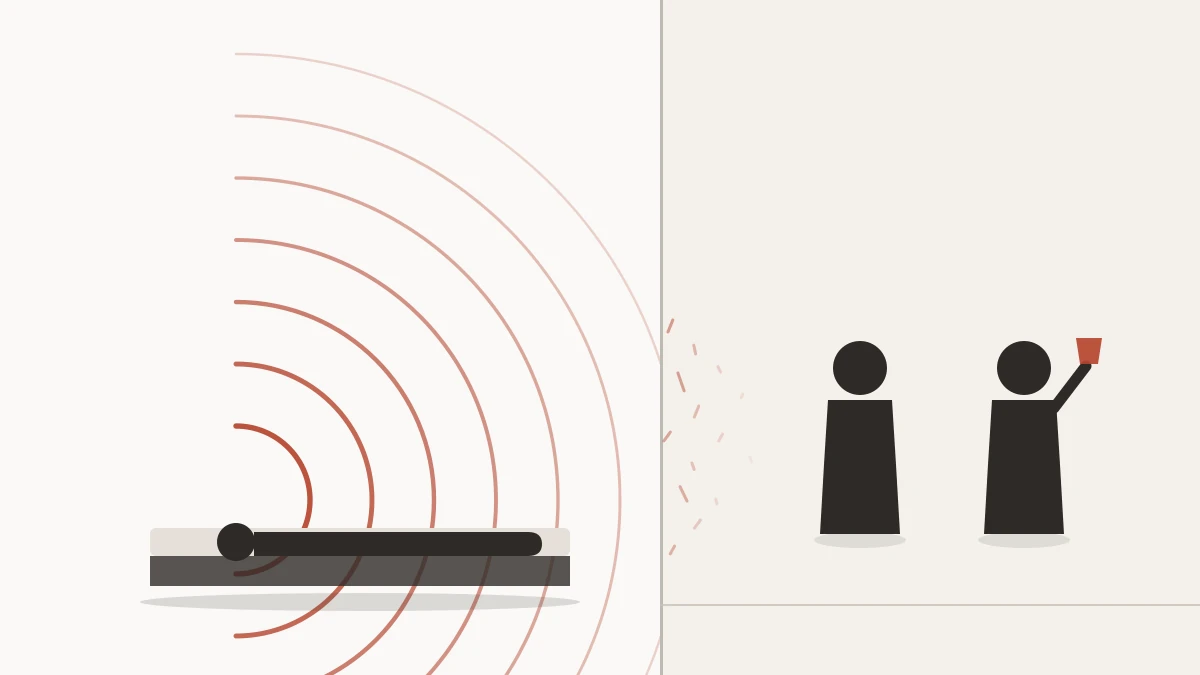
Halfway through, Joel changes his mind. He runs through his own memories watching Clementine’s eyes go vague, watching the sets peel away in pieces. The screenplay has him screaming up at a collapsing night sky, asking whether they can hear him, telling them he wants to call it off, promising to give them a sign.
Then the film cuts to the bedroom. The stage direction is barely a line long: his eyes roll almost imperceptibly. Stan and Mary are dancing. Nobody is watching the monitor.
He already knows he can’t stop it. Earlier, inside the memory, he says it plainly: he can’t cancel, he’s asleep; he took a pill and can’t simply wake up.
By this point only two people are left in the apartment. Patrick has already phoned Stan to say he “got into a situation with the old lady” and that Stan will have to handle the night alone — he is across town in Clementine’s apartment, pulling from his backpack the red gift box Joel had bought her for Valentine’s Day. Stan’s reply on the phone: he can handle it, the guy is pretty much on auto-pilot anyway. The screenplay notes that Stan is badly stoned by now, and so is Mary.
That is a complete horror sequence: a man screaming inside his own consciousness while a sedative he swallowed himself holds his body on the bed, and the two people still in the room are high and dancing — neither of them hears a thing, one of them holding his liquor. Nobody restrained him. That is what makes it harder to watch: from tearing out the journal pages to swallowing the pill, every step that put him under was one he performed on himself.
It escapes the genre label largely because the camera chose to stay inside rather than outside. Shoot the identical scene from the bedroom’s point of view, drop in a low hum, and few people would misidentify what they were watching.
The look supports it. The film uses very little CGI; most of its effects were achieved on set, through forced perspective, hidden space, spotlighting, unsynchronised sound, split focus and editing (see sources). My reading of that choice: it makes the collapse look like something happening rather than something added afterwards. Rooms are struck like stage sets mid-sentence, faces go unreadable in the middle of a conversation, a beach house folds in on itself — and the seams stay visible. What Gondry himself has said is a different point pulling the same way: they did not want to make a science fiction movie, and Lacuna’s procedure was a device for exploring a nostalgia that is uncontrollable. The operative word is uncontrollable. The technology was never the subject. Losing control of it is.
Against the film: the sharpest idea gets played as comedy
The film falls short of the top of my scale, and the deductions are specific.
The first is a tonal fracture in the Lacuna subplot. While erasing Joel, the technician Patrick takes his memories — he sits and monitors the intimate details of Joel and Clementine’s relationship — and uses them as a script to pursue the freshly emptied Clementine. He repeats another man’s words, restages another man’s gestures, and lets a woman with no memory believe she is falling in love.
Conceptually this is the most frightening thread in the film. It pushes the commodification of memory to its logical end: your private experience becomes someone else’s seduction script, and the victim has no way to detect the fraud. Filmed seriously, it could carry an entire thriller.
Instead Patrick is written as a hapless clown — panty thief, punchline, too inept to be threatening. The audience is steered toward finding him pathetic rather than terrifying. The result is that the main line and the subplot are arguing different cases: one insists that taking someone’s memory is violence, the other treats the same violence as a running gag. Films need release valves. This one chose the wrong material to joke about.
The second deduction concerns Clementine, and it is structural. The bulk of the film takes place inside Joel’s head, which means most of the Clementine we get is Joel’s remembered version — assembled out of his perspective, his moods, his grievances. The film knows this. Near the end it lets her refuse the terms directly, telling him she isn’t a concept, just a messed-up girl looking for her own peace of mind, and that she isn’t perfect.
It is a strong line. But it arrives in the final scene of the film, and it asks the very character who has been imagined for most of its running time to get the film off the hook. Recognising a problem is not the same as solving it. A film critiquing the reduction of a person to a concept spends most of its structure able to show us only a conceptualised version of her. That tension is unresolved, and I don’t think naming it is nitpicking.
Two decades on: the prophecy wasn’t the technology
The film is routinely called prescient. That claim needs narrowing, or it becomes false.
Take the science first. In 2004 memory research was mid-turn. Nader, Schafe and Le Doux had published a 2000 paper in Nature showing that consolidated fear memories, once reactivated, return to a labile state and require fresh protein synthesis to restabilise — what became known as reconsolidation. Memory, on this account, is not a file on a disk but something rewritten every time it is read. The film’s own description of the procedure — every memory has an emotional core, eradicate the core and the memory begins to degrade — points in the same direction. Slate ran a science check on 22 March 2004 whose subtitle already had the calibration right: you can’t erase your boyfriend from your brain, but the movie gets the rest of it right.
Two decades of clinical work have not followed through. Propranolol is the most studied candidate, and in 2022 a systematic review and meta-analysis in the Journal of Psychiatric Research concluded there was a lack of evidence for its efficacy in disrupting traumatic memory sufficient to recommend routine clinical use. The same year, a corrected meta-analysis in the Journal of Psychiatry and Neuroscience, restricted to low-risk-of-bias randomised trials, found no advantage over placebo at all.
So: erasing a painful memory remains clinically unproven. Anyone claiming the film’s premise is nearly here is arguing against the current evidence.
What did arrive is the other half. The film imagined a machine that deletes. What we built is a system that curates — and whose default behaviour is to surface memories, not remove them.
In December 2014 the web designer Eric Meyer opened Facebook’s Year in Review and found the photograph the system had chosen to represent his year: his six-year-old daughter, who had died of brain cancer that year, framed by dancing clip-art revellers. His essay, “Inadvertent Algorithmic Cruelty,” is unnervingly calm about the mechanism — algorithms, he wrote, are essentially thoughtless; they model decision flows, and once you run them no more thought occurs. The design, he added, is for the ideal user: the happy, upbeat, good-life user.
The platforms’ eventual fix is where the film’s real prophecy lands. Open Google Photos today, go to Memories, choose Hide faces, and pick a person. The official documentation is precise about the two settings: choose Show less and you won’t get memories about them, though they may still appear in group photos; choose Blocked and they won’t appear in memories, including group photos with others. Facebook offers the equivalent for people and for date ranges.
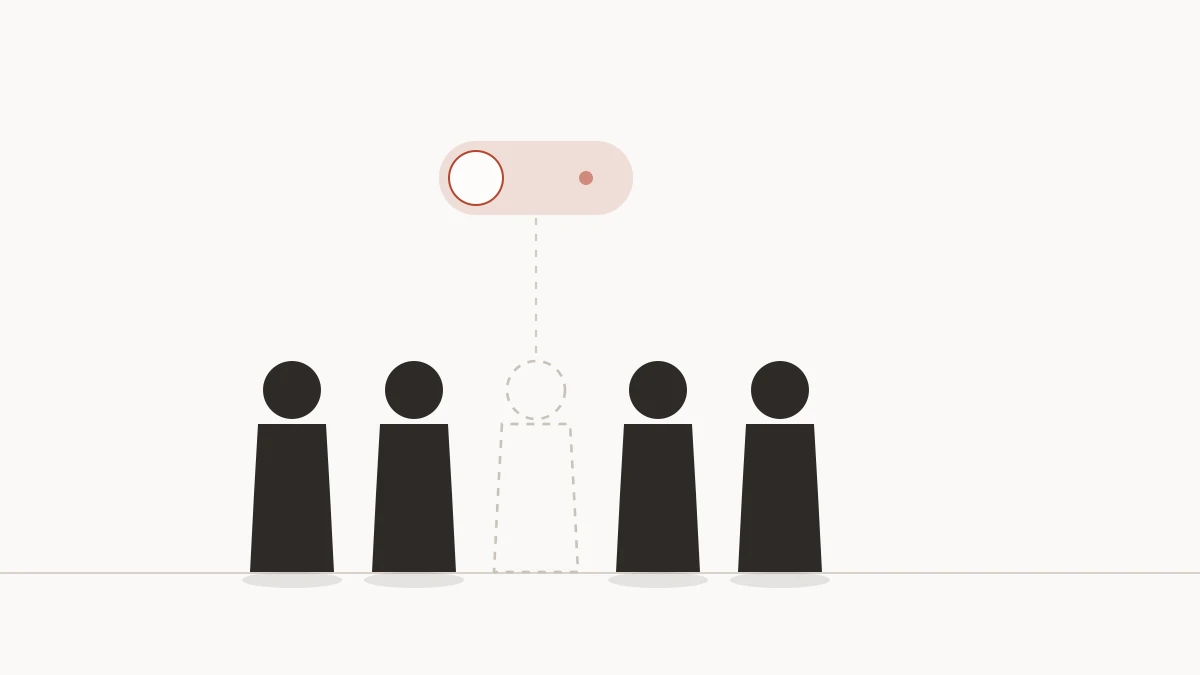
Lacuna didn’t become a medical device. It became a toggle in a settings menu — and a colder one than the film’s. The movie at least made Joel stuff every object associated with her into two bin liners with his own hands, haul them across the city, and sit through a ritual in a waiting room. That ritual is itself a goodbye, even though he didn’t know it was one at the time. The real version takes two taps: no consultation, no bags, none of that walk carrying your own past, and nobody drinking in your bedroom.
That is why the 2003 pitch stings now. Not because the technology caught up, but because the appetite was confirmed: lower the cost far enough and people really will choose to make someone disappear from their own recollection. What the film treated as an absurdity requiring an entire company is now a free feature.
The last word isn’t “I love you”
The misreading of this film as a romantic classic rests almost entirely on its ending — and the ending collapses the moment you read the last exchange as written.
The two of them are in a hallway. Joel stops her with a request that comes out as nothing more than a wish that she wait a while. Clementine laughs and agrees. Then she refuses to be a concept.
And then — this is the part that matters — she forecasts the future without being asked. He tells her he can’t think of anything he dislikes about her right now. Her answer: but you will. You will think of things. And she will get bored and feel trapped, because that is what happens with her.
Joel says: Okay.
She says: Okay.
End of film. The final word is not “I love you.” It is “okay” — and it is said by both people after they have heard, out loud, that this will very likely break again.
That is not love conquering all. It is informed consent. Two people receive the worst available information about each other — including the fact that they once got bad enough to have one another surgically removed — and choose to go again anyway. The film declines to say whether it works, because that was never the question. The question is whether they can choose while knowing, instead of starting over emptied.
Which returns us to the title. Pope’s eternal sunshine is a state Eloisa envies and cannot reach; it is a synonym for escape. The film spends its whole running time saying the same thing with one update: you can actually buy that state now, it isn’t even expensive, and what you become afterward is Mary — smiling, speaking in borrowed quotations, with no idea what was done to her.
Why 9.1
On the axis of form-as-argument, this is as good as anything I’ve seen in its class. It doesn’t describe amnesia, it administers one; it doesn’t denounce memory deletion, it lets you reach the end and realise what you were fooled about at the start. Title, poem, characters and structure interlock across four layers, and not one of them is decoration.
The deductions are equally clear. Patrick’s thread is the sharpest weapon the film has, and it is blunted by being written as comedy. Clementine’s interiority is constrained by the premise that we are inside Joel’s head; the film admits the problem in a line of dialogue without ever structurally answering it.
9.1 means: watch it a second time, and expect the second time to be scarier. If you’ve seen it once and what you retained was the romance, you saw exactly the layer the film builds first in order to dismantle it later.
Sources
- Charlie Kaufman, Eternal Sunshine of the Spotless Mind screenplay (Goldenrod Revision, 4 February 2003): PDF
- Alexander Pope, “Eloisa to Abelard” (1717): full poem on Wikisource
- Nader K, Schafe GE, Le Doux JE. Fear memories require protein synthesis in the amygdala for reconsolidation after retrieval. Nature. 2000;406(6797):722-726: PubMed
- Raut SB, et al. Effects of propranolol on the modification of trauma memory reconsolidation in PTSD patients: A systematic review and meta-analysis. J Psychiatr Res. 2022;150:246-256: PubMed
- Steenen SA, van Westrhenen R, de Lange J, de Jongh A. Updated and rectified meta-analysis shows no effect of propranolol versus placebo on traumatic memory reconsolidation disruption. J Psychiatry Neurosci. 2022: full text on PMC
- Eric Meyer, “Inadvertent Algorithmic Cruelty” (24 December 2014): original post
- Google Photos Help, “Find & manage your featured memories”: official documentation
- Steven Johnson, “The Science of Eternal Sunshine,” Slate, 22 March 2004: article
- Matt Mansfield, “Ten years of Eternal Sunshine of the Spotless Mind,” Dazed, 13 March 2014 (quoting Gondry’s 2004 interview): article
- Credits, awards and box office: Wikipedia entry (Screenplay by Charlie Kaufman; Story by Kaufman, Michel Gondry and Pierre Bismuth; the three shared the Best Original Screenplay Oscar at the 77th Academy Awards)