In the Mood for Love (2000): Absence Isn't Its Mood, It's Its Structure
花樣年華 (2000)
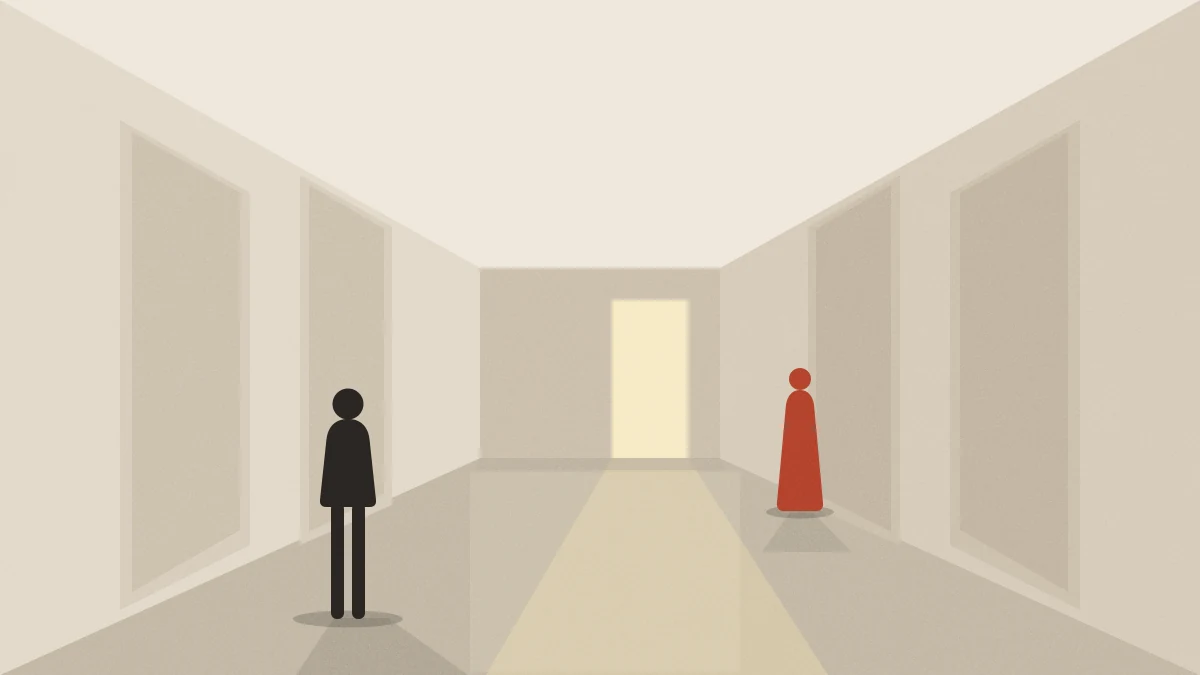
The most useful thing ever said about In the Mood for Love came from someone who hated it.
The film premiered at Cannes on 20 May 2000. Recalling the run-up twenty-five years later for Sight and Sound, Wong Kar-wai described a print that arrived in mono, an edit finished at the last possible moment, and a crew convinced the screening would be a catastrophe. The film’s Italian distributor was furious enough to threaten legal action, and his complaint was a question: where are the love scenes?
He had grounds. A sex scene between Maggie Cheung and Tony Leung had been shot and cut. An entire strand set in the 1970s had been shot and cut. What the distributor had bought was a film about adultery; what he was handed was a film in which nobody crosses the line.
Asked in 2025 whether he would make the same cuts today, Wong did not hedge. He would cut them again, he said, because the film is about absence — what is missing matters as much as what is there.
That sentence is worth reading as an engineering statement rather than a poetic one. What makes this film rare is not that it is restrained. Restraint is taste, and taste is cheap. What makes it rare is that it promotes omission from a flourish to a load-bearing structure.
One Film a Day’s verdict: In the Mood for Love is one of the very few films that treats withholding as its primary structure rather than its decoration. Repeated corridors, repeated staircases and slow motion take over the work that plot would normally do, forcing the audience to finish the relationship inside the gaps. The cost is that the characters’ motives get outsourced wholesale to form — and for a viewer who never locks into the rhythm, there is almost no way to understand why these two stop. 9.2.
In an era of streaming platforms that show you everything and then autoplay the next thing before you have finished breathing, that kind of withholding is scarce for a structural reason, not a moral one: to make omission carry a feature film, you have to build an entire replacement system somewhere else. This one did.
The film was never about the affair
Start with what got removed, because it explains how what remains works.
The project did not begin as a romance. Wong’s original plan was a triptych about food — three eras, three inventions that reorganised domestic life in Asia: the 1960s rice cooker that freed women from the stove, instant noodles in the 1990s, the 24-hour convenience store. The 1960s panel was supposed to be one third of a mosaic. It grew into the whole film. The rice cooker survives in the finished picture not as set dressing but as the first domino: a trophy the husband brings back from Japan that ends up implicating him.
The spine came from elsewhere — Liu Yichang’s novel Duidao (Tête-Bêche), a philatelic term for two stamps printed head to tail. The closing credits list the film as incorporating quotations from Liu’s writing, and Sight and Sound’s 2000 review recorded the same credit. That structure is not a footnote; it is the method. Two betrayed people invert themselves into the betrayers, rehearsing again and again how “it must have started.”
Once that is clear, the deleted sex scene stops being a question of decorum and becomes a question of load. The film’s real subject is not whether they will sleep together but at what point they stop being able to tell the rehearsal from the thing itself. Wong’s own description is that by the end neither character can separate performance from truth. A consummation scene answers that question instantly — and the entire structure is built on the audience not having the answer.
When the beat takes over from the plot
The corridors and the slow motion are the most imitated thing in this film and the most misread. Their job is not atmosphere. Their job is timekeeping.
Shigeru Umebayashi’s “Yumeji’s Theme” was not composed for this picture at all: he wrote it in 1991 for Seijun Suzuki’s Yumeji, and it entered In the Mood for Love as temporary music that Wong then refused to give up. His reason is specific — the plucked string figure sounded like a heartbeat, something primal the film could be built on. He has described letting the music lead the camera, staging what amounts to Swan Lake inside a room ten feet square.
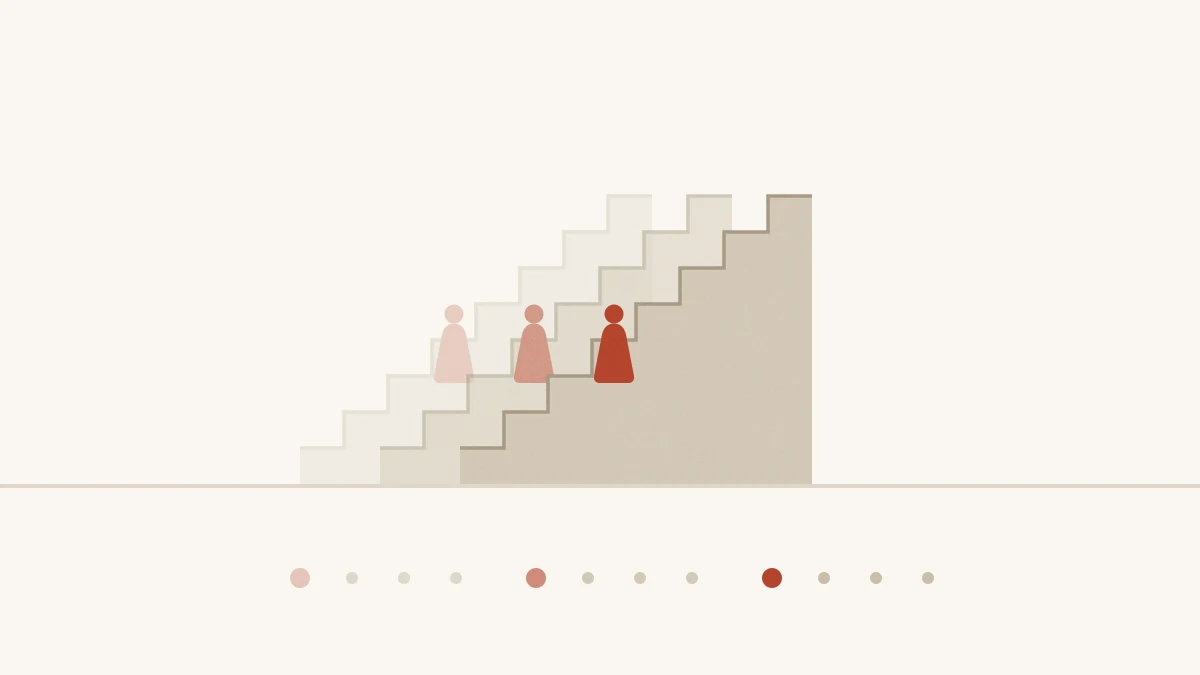
So the repeated passages become a metronome. Mrs Chan takes her thermos down for noodles; she passes Mr Chow on the stairs; the same slow three-time figure plays. Sight and Sound’s 2000 review counted the shot of the camera trailing her up the staircase recurring at least three times, each pass carrying the same dissonant, slowed mazurka.
Here is the mechanism: every repetition means something different, and the film never once explains the difference. The first pass is two strangers. The second is two people who know exactly what their spouses are doing, pretending to be strangers. The third is two people who can no longer be strangers, still passing as strangers. Identical music, identical camera position, identical stairs — the only variable is how much the audience now knows. That is what omission-as-structure looks like in practice: the information does not live in the frame, it lives in the gap between the frame and the viewer.
Wong puts it harder than most critics do. Repetition, he says, is how memory works: the same song, the same stairs, meaning something different each time. Then the qualifier that matters — this is not nostalgia, it is haunting. Nostalgia is warm. Haunting is cold. The film is routinely received as the former while its form is doing the latter.
Cannes gave the technical prize to three people
One frequently mangled fact deserves correcting. At the 2000 festival, this film did not simply win Tony Leung the Best Actor award. According to the festival’s own record, the Grand Prix de la Commission Supérieure Technique went to Christopher Doyle, William Chang Suk Ping and Mark Lee Ping-bin — three names, not a cinematography credit.
That distinction explains why the style holds up. William Chang was simultaneously production designer, editor and costume designer, a triple credit anyone can verify on the Criterion release. Which means the decision about when a cheongsam changes pattern, where a shot gets cut, and what colour a wall is painted came out of a single head. That is why the dresses function as a calendar rather than as decoration, and why shots so often end before the gesture inside them does: the rhythm of the cutting and the rhythm of the wardrobe are the same instrument.
The photography was not a single hand either. Doyle shot roughly 80 per cent of the film before departing; Mark Lee Ping-bin took over. Wong’s account of the difference is unusually concrete: Doyle was jazz — improvised, explosive; Lee was classical and precise. He wanted both, the agitation in the corridors from one, the stillness in the close-ups from the other.
This is the reason to reject the “it’s just atmosphere” reading. The film is a dismantlable piece of engineering — who supplies the agitation, who supplies the stillness, who keeps the costumes and the cuts on the same clock. Cannes, by naming three people, acknowledged as much.
The crime is not the betrayal. It’s being seen
Which brings us to the claim most often made about this film: that it turns an affair into the most morally scrupulous thing on screen.
The direction of that claim is right and the attribution is wrong. The scruple does not originate in the characters’ willpower. It originates in the architecture — more precisely, in the neighbours’ eyeline.
Wong has laid out his reference points. He admires Brief Encounter for its longing and restraint, but says most adultery films are about guilt or passion, whereas he wanted complicity — a shared secret. He also invokes Rear Window, with one adjustment: Hitchcock’s neighbours witness a murder, his witness a relationship. Then the conclusion: the real crime is not the betrayal, it is being seen.
That single sentence contains the film’s entire spatial logic. Mrs Suen’s flat always has a mahjong game running, someone in the hallway, someone on the stairs; the partitions between rooms are thin enough to be decorative. On one occasion Mrs Chan avoids being seen leaving Mr Chow’s room by staying in it all night — the sharpest irony in the picture, because preserving the appearance of innocence requires the least innocent act available.
The moral gravity, in other words, is a by-product of surveillance. That is not a criticism; it is the film’s advantage over most romances. It never writes restraint as a virtue. It writes restraint as the shape of a situation. Part of why these two never cross the line is that they genuinely do not want to; the other part is that in that building, crossing it would be witnessed by everyone. No character ever says this. The film simply keeps the camera behind a doorframe, a window frame, or at the far end of a corridor, so that you are always watching through something. The camera position is the argument.
Hands, the far end of the phone, and a hole in a wall
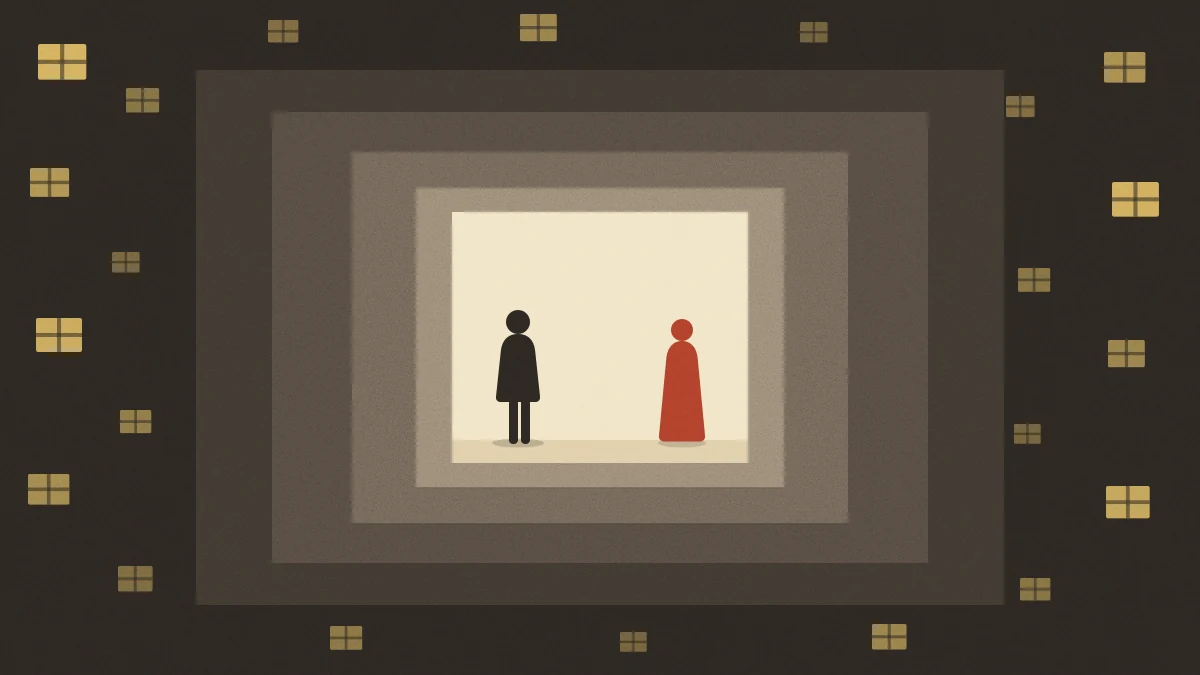
If you withhold the obvious, you have to give the audience somewhere else to look. This film gives them hands.
Wong’s account of the motif is one sentence long and entirely practical: hands betray what faces hide. He told his leads to let their hands do the talking — the cigarette, the letter, the moment a hem is gripped. That is a director’s solution to a director’s problem: having declined both the emotional close-up climax and the physical one, you must pack the same quantity of information into much smaller gestures.
The same logic governs everything else. Phone calls are shot from one end only; who is on the other end, and what they say, is the audience’s job. The two spouses never appear frontally — a voice, a back, a name mentioned in passing. And in the coda, Mr Chow travels to Angkor Wat, whispers his secret into a hole in a wall and seals it with mud. The film does not let you hear the secret either.
That ending is a deliberate break. A mid-film title card states that the era is over and nothing belonging to it survives; the closing card describes the past as something he could see but not touch. Moving from a 1962 apartment to a 1966 ruin, the film scales “cannot be touched” up from the condition of one affair to the condition of an entire period.
It is worth knowing how late that decision came. Wong has said plainly that many of these choices were made at the eleventh hour against the Cannes deadline — the 1970s material was dropped at that stage and the Angkor Wat coda took its place. A film whose structure is built on subtraction arrived at that structure on an editing bench, under a deadline. That does not diminish the result, but it should adjust the myth: this completeness was not planned, it was cut.
The one real weakness: motive outsourced to form
Now back to the Italian distributor, whose objection sounds philistine and is in fact a valid critique.
In the Mood for Love assigns causation to style. Why do these two stop? The film’s answer is corridors, staircases, cheongsams and pizzicato. For a viewer inside the rhythm, that answer lands completely. For a viewer outside it, no answer has been given. Unlike Brief Encounter, the film never lets its characters articulate the struggle; unlike most narrative cinema, it declines to force the choice through events. It puts the entire weight of the decision on form.
Wong himself supplies the sharpest evidence. Mr Chow was originally conceived as considerably darker — a man wrecked by his wife’s betrayal and driven by spite, out to prove Mrs Chan was no different, a cruelty Wong compares to James Stewart’s obsession in Vertigo. That version was softened. He says the shadow stayed, but the edge came off. The problem is that when the edge came off, the screenplay did not replace it; Tony Leung’s performance and William Chang’s cutting replaced it. The substitution is superb — good enough that Cannes gave it Best Actor — but it is a performance doing a screenplay’s job. That is where the missing 0.8 goes.
The weakness has an aftermath, too. Once form carries the narrative, form can be lifted away from the narrative and reused on its own. For twenty-five years, cheongsams, slow motion, narrow corridors and red neon have been borrowed as “mood” by work with no structure underneath — and this film bears some responsibility for that, having proved so thoroughly that the vocabulary can operate independently. People took it at its word.
One practical footnote: the version available now may not be the version you remember. In the director’s note he wrote for the 2021 restorations, Wong explains that In the Mood for Love was shot and released theatrically at 1.66:1 and only converted to 1.85:1 for home video, and that when restoring it he chose his original conception over the audience’s memory. His closing line is unambiguous: these are not the same films, and we are no longer the same audience. As for the yellow-leaning grade that upset a good number of viewers, Sight and Sound notes his position — that is how he always wanted the films to look. If a rewatch feels warmer and narrower than you remember, your memory is not the problem.
What 9.2 means
The credit side first. This film proves something genuinely difficult: that two hours can be organised almost entirely by beat, repetition and sightline rather than by plot. It is not “beautifully shot” — beauty is the output, not the method — it is a film in which photography, cutting, costume and score are wired into a single timing system, so that the audience completes the picture precisely where information has been withheld. That was a risky bet in 2000, and the distributor’s rage is the evidence. Twenty-five years of voting has since backed it: BBC Culture’s 2016 poll of 177 critics on the greatest films of the 21st century placed it 2nd, behind Mulholland Drive; the BFI’s 2022 Sight and Sound poll, with 1,639 participants, placed it 5th — the highest-ranked 21st century film on the list.
The debit side is a single item, but a real one: motive is outsourced to form. This is not the “too slow, too quiet” complaint, which is a matter of taste and has no business affecting a score. It is a gap in the text itself — Mr Chow’s interior turn is never completed at the level of writing, and performance and editing cover for it. That gap is what stands between this film and a perfect score.
So 9.2 means, concretely: worth a dedicated rewatch, and worth watching somewhere you can concentrate. This is not a film to leave running in the background. Lose the thread and the repeated staircases become merely handsome empty shots, and the whole structure collapses into mood. If you are watching a restoration, it also helps to know in advance that the aspect ratio and the grade were changed by the director on purpose, so you don’t misfile a version difference as a failure of memory.
Whether it is a “classic” is not, in itself, a reason to watch anything. The reason this one still works is specific and technical: it demonstrates that in an era of informational excess, withholding information is the stronger narrative move. That conclusion will outlast any poll it appears on.
Sources
- Wong Kar Wai on In the Mood for Love at 25 — Sight and Sound / BFI (20 May 2025, interview by Sam Wigley) (the deleted sex scene and 1970s strand; “the film is about absence”; the food triptych and the rice cooker; Liu Yichang’s Tête-Bêche; Rear Window and “the real crime is being seen”; the hands motif; Doyle’s 80 per cent and Mark Lee’s handover; “Yumeji’s Theme”; repetition as memory; Mr Chow’s original spite; the chaos around the Cannes premiere; the yellow grade)
- Festival de Cannes official awards record, 2000 (Tony Leung, Best Actor; Christopher Doyle, William Chang Suk Ping and Mark Lee Ping-bin, Grand Prix de la Commission Supérieure Technique; Palme d’Or to Dancer in the Dark)
- In the Mood for Love — The Criterion Collection, spine #147 (98 minutes; 1.66:1; Cantonese; William Chang’s triple credit as production designer, editor and costume designer; deleted scenes with Wong’s commentary on the disc)
- World of Wong Kar Wai: Director’s Note — written by Wong Kar-wai (Criterion, 23 March 2021) (original 1.66:1 ratio, the 1.85:1 videogram conversion, choosing his original vision over audience memory, and the closing address to viewers)
- In the Mood for Love — Sight and Sound review by Amy Taubin, 2000 (BFI legacy site) (the staircase shot recurring at least three times; the credit “Spanish Songs Sung by Nat King Cole” and the Liu Yichang quotations; the wording of both title cards; the 1962/1963/1966 chronology)
- The Greatest Films of All Time — BFI Sight and Sound critics’ poll, 2022 (5th place; 1,639 voters)
- The 21st Century’s 100 greatest films — BBC Culture, 2016 (2nd place; 177 critics polled; Mulholland Drive 1st)
- Notes on In the Mood for Love — Charles Yu (Criterion, 1 November 2022) (the year-plus shoot and the discarded material)
- Shigeru Umebayashi interview — Cinezik (“Yumeji’s Theme” written in 1991 for Seijun Suzuki’s Yumeji, used first as temp music and then kept)
All three illustrations in this piece were drawn in-house for One Film a Day. They contain no film stills, poster compositions or likenesses of any performer.