Parasite (2019): The Class Allegory Is Its Weakest Layer. The Staircase Is the Masterpiece.
기생충 (2019)
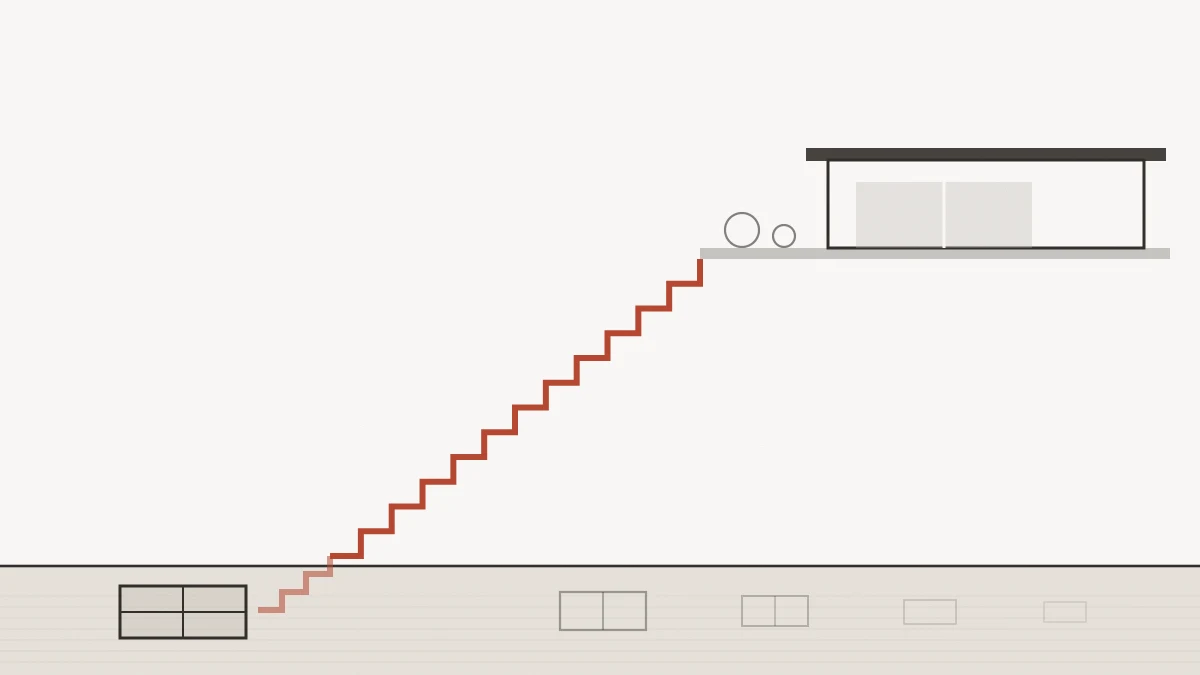
The most useful sentence about Parasite is not in the film. It is a stage direction on the second page of the shooting script, and it goes like this:
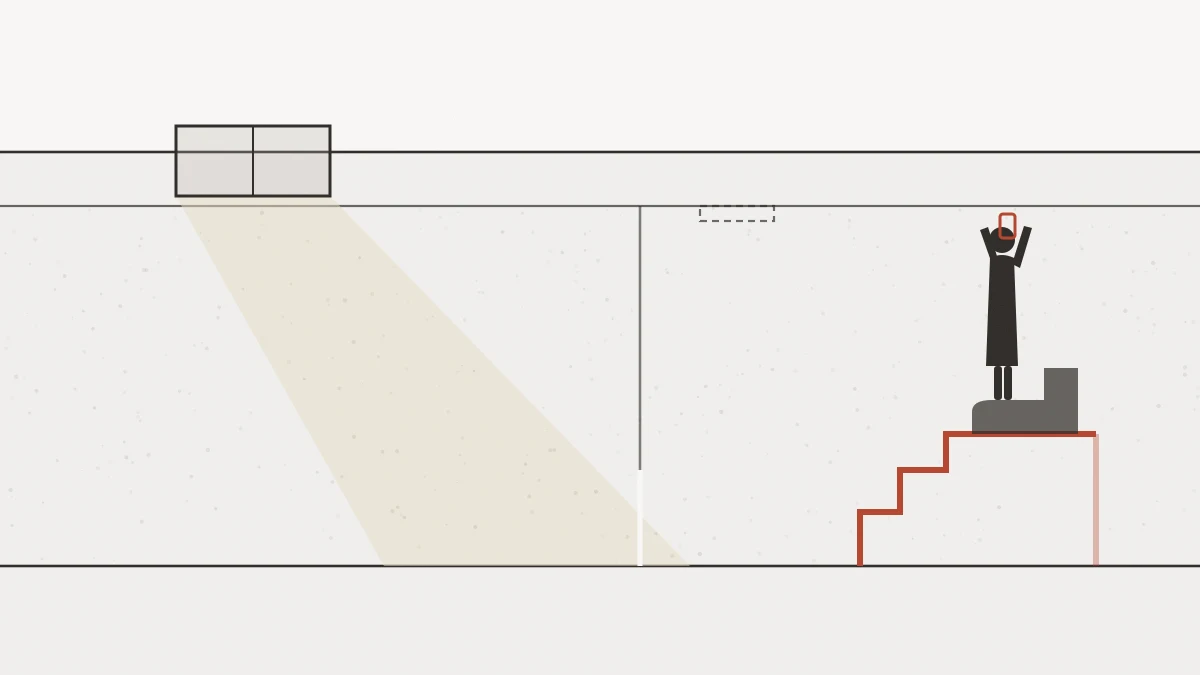
The bathroom is long and narrow and has a raised ‘altar’ at the far end where the toilet sits. The odd placement is necessitated by the semi-basement’s lower position in relation to the septic tank.
That is plumbing, not metaphor. If you live below street level, your waste has to be pushed up to reach the sewer, which means the lowest room in the poorest home in the film contains its highest platform. In the first scene after the title card, the Kim siblings are crouched on that platform with their heads against the ceiling, phones held aloft, hunting for an unsecured Wi-Fi signal — and the first line their father speaks in the entire film is an instruction about altitude: “One must reach into the heavens. Up.”
Everything Parasite is going to do for the next two hours is already in that shot. Going up is a physical act performed with the body. You can perform it perfectly and still be underground.
One Film a Day’s verdict: the achievement of Parasite is not its class allegory — that is the layer serious critics have punctured, and they were right to. The achievement is that it makes verticality the only dynamic the story has. Every narrative advance is a literal change in elevation rather than a symbol of one. Strip out every sociological line of dialogue and the staircase keeps working. As for the third-act genre swerve so often called a lapse: it is not a lapse, it is the only value the spatial equation resolves to — but it has a price, and the price lands exactly where the film’s sharpest critics say it does. The poor do most of the bleeding. 9.0.
The first concept was not class. It was water running downhill.
Production designer Lee Ha-jun states the art department’s starting point plainly in the official Cannes press kit:
“The first concept that we came up with for the film was the contrast between the elevated house of the Park family and the low-lying semi-basement flat of Ki-taek’s family, just like how when it rains, water flows from the top of a hill to the bottom.”
Note where that sits in the process. It is the first concept, not an interpretation arrived at in the edit. In the same statement Lee mentions something more consequential still: the Park house was purpose-built as an open set, and “on the director’s instructions, we also created corners and angles where one character could stand without being completely visible to the other characters.”
Which is to say the film’s celebrated hiding places — under the sofa, under the table, around the turn of a stair — were not camera positions discovered inside an existing house. They were architectural requirements drawn into the plans. The geometry of sightlines came before the plot that would exploit it.
The construction budget makes the same point more bluntly. Lee told Screen International that the Park house and its lawn were built in Jeonju, in the country’s south-west, while the Kim family’s semi-basement and their entire alley were built on a water tank set in Ilsan, north-west of Seoul — for the frank reason that the neighbourhood was eventually going to be flooded, then drained, cleaned, and repapered so the aftermath could be shot. The poor district existed, from the day its foundations were poured, in order to be filled with water.
Every other decision aligns the same way. The rounded trees on the Park lawn are deliberate: “Trees are not naturally round,” Lee said. “That requires constant maintenance by a gardener. It’s a symbol of wealth” — and they set off the straight lines inside the house. The multi-level living room table was made for the film by furniture artist Bahk Jong Sun; it is the one the Kims later spend an unbearable stretch of screen time hiding beneath. Even the table is tiered.
None of this is production trivia. It is the basis of this site’s assessment. When a film commits engineering money to the proposition that the water must genuinely be able to pour in, it has stopped using space as a figure for class and started using space to execute it.
“Our staff jokingly called our work a stair movie”
At the official Cannes press conference on 22 May 2019, Bong gave the quote that gets cited constantly, usually with its second half cut off:
“Nearly 90 percent of the story takes place in a big house, the home of the rich family. It has a vertical structure — second floor, first floor and basement. Each space is connected by stairs. Our staff jokingly called our work a ‘stair movie.’”
(That proportion deserves a footnote: the official press kit says “more than 60%” of the film unfolds in the Park house. Both figures come from official channels, so both are printed here rather than the one that flatters the argument.)
He traced the idea to Kim Ki-young’s The Housemaid (1960), then added the part that actually matters:
“In South Korea, the semi-basement has subtle nuances. (People) live underground, but want to believe that they are above the ground because they have a moment when sunlight comes into their room.”
“But at the same time, they are afraid of falling into a complete underground situation if they get worse.”
That is why the film’s space cannot be flattened into “upstairs and downstairs.” A semi-basement is an intermediate position that is actively sliding, and the sliding is the horror.
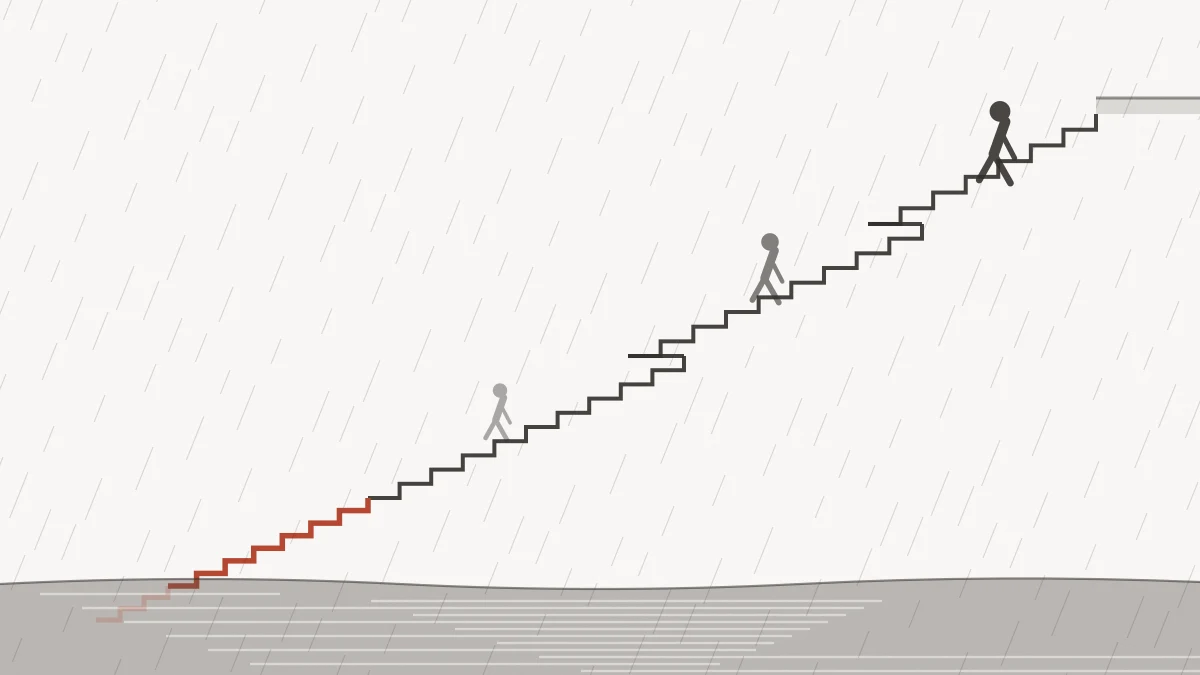
The proof is the long descent on the night of the storm. Here are the script’s scene headings in order, because they read less like a sequence than like an altimeter log:
- The three of them crawl out of the garage and walk down the winding road;
- Street: they trudge along a gloomy four-lane road, “no longer in the nice part of town”;
- Hilltop: “We look down on a hillside neighborhood. A different hillside view. Working class. Illuminated by the lights of low-income apartments. The gates of poverty.”
- Alley: “A completely flooded alley!” Sewage backflows; a neighbour bails out his own semi-basement with a bucket.
Four scenes, four elevations, all downward, and not one of the cuts is a jump. This is what narrative advance as literal descent means in practice: what the Kims lose that night is not their dignity or their scheme. It is altitude. Meanwhile, across town, the Parks’ disaster of the evening is that their son insists on sleeping in a tent on the lawn while his mother watches him through the glass. The same rain falls on both families; it runs off one family’s grass and into the other family’s living room.
The same toilet settles the account later. The script has it “spewing shit water like an Icelandic geyser”; Ki-jung forces the lid down, climbs on top, opens a square panel in the ceiling and retrieves the cigarettes, lighter and folded banknotes she keeps hidden up there, and smokes while “the surging sewage lifts her toilet seat up and down.” The same platform, used twice — first to reach a signal, then to reach a cigarette — with nothing changed between the two but the water level. Note also where this family hides its money: in the ceiling. Even their savings have to be stored at the top of the vertical axis.
And the one moment in the film when class genuinely disappears happens on a gymnasium floor. In the evacuation centre, Ki-woo presses his father for the plan, and Ki-taek delivers the line everyone quotes without noticing what plane it is delivered on:
“Do you want to know how you make a foolproof plan? Don’t plan at all. Have no plan.”
“Look around. Do you think these people got up this morning and said ‘Tonight I’m going to sleep on a dirty floor with hundreds of strangers’? But look where they are now. Look where we are.”
It is the only scene in which every character occupies the same height, and that height is the floor. The film’s sole image of equality is a disaster flattening everyone — which tells you more about its pessimism than any line of dialogue does.
Smell is the last leg of the vertical axis
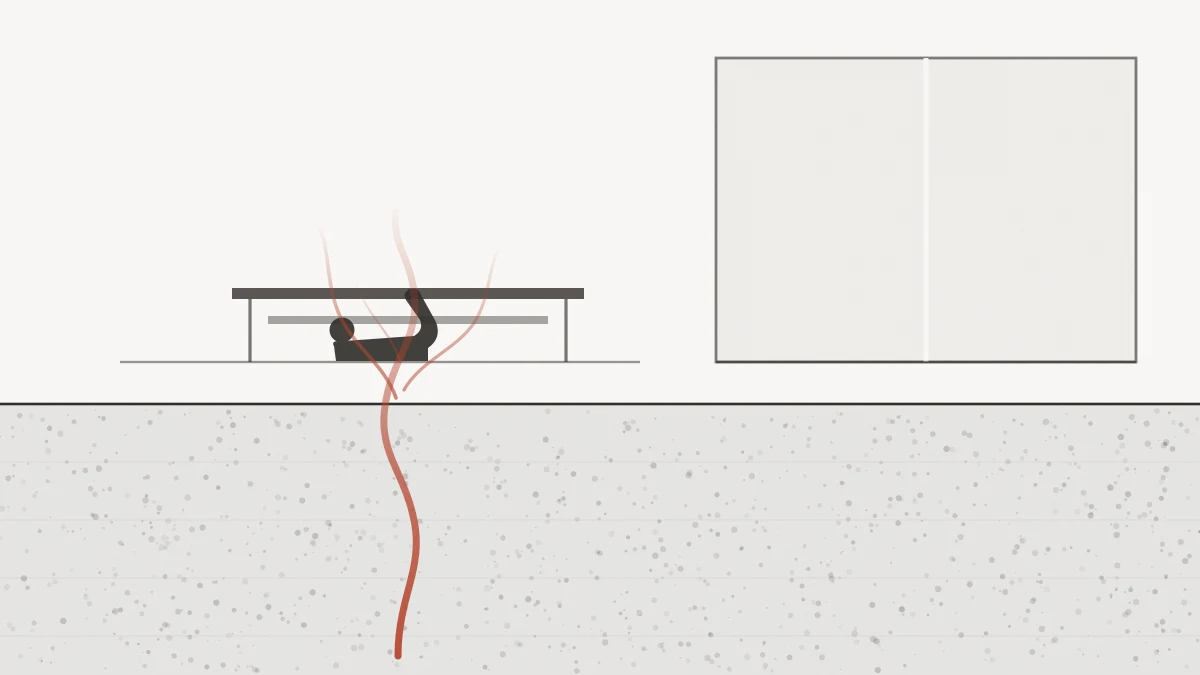
The long scene with the Kims trapped under the coffee table is where the film ties space and humiliation together hardest. Mr Park, lying on the sofa a few feet away, describes his driver’s smell to his wife:
“No. It’s not that strong. It’s more like a subtle aroma that seeps into the air— Maybe the smell of an old radish pickle? Or that smell when you’re washing a dirty rag?”
The script’s only stage direction for the man listening from under the table: “Ki-tek is completely expressionless.”
The lethal part is the appraisal that follows:
“I mean I like his driving. And the man never crosses the line. Sometimes he teeters very close, but he never actually crosses it. That’s all great. But that smell. It definitely crosses the line.”
“The line” is the film’s keyword, and it is spoken three times, each occurrence revising the last. First, Mr Park praises the outgoing housekeeper: “Most importantly, she never crossed the line. If there’s one thing I hate, it’s people who cross the line.” Second, under the table: the body can approach, but the smell crosses without permission. Third, on the day of the party, Ki-taek hands the word back — “Mr. Park. I think you went over the line.” Mr Park stiffens and asks what he just said; Ki-taek points to a feather poking through the bottom of his headdress and says, “No. I mean this.” The script adds: “He still can’t shake the feeling that Ki-tek was talking about a different ‘line.’”
In the same press kit, Bong states what the word is for:
“In today’s capitalistic society there are ranks and castes that are invisible to the eye. We keep them disguised and out of sight, and superficially look down on class hierarchies as a relic of the past, but the reality is that there are class lines that cannot be crossed.”
So the vertical axis runs through three scales: the difference in building height, the staircase a body has to physically traverse, and finally an odour that crosses without the body moving at all. At that third scale the victim has no move left. You can decline to go upstairs. You cannot decline to smell.
This layer is more than a good metaphor because it has a referent. Per the Korean statistical agency’s 2020 housing census, at least 327,320 households nationwide live in semi-basement or basement dwellings; 95.9% of them are in the capital region, and Seoul alone accounts for over 200,000 — 61.4% of the national total. The dwellings are a Cold War artifact. After the 1968 Blue House raid, the government rewrote the building code so that homes built through the 1970s had to include an air-raid basement — and those basements were, at first, explicitly barred from being rented to anyone; they were for storing supplies and sheltering from bombs. Only in the 1980s, with Seoul’s population surging and housing far short of demand, did the state legalise renting them out. They are poorly lit and poorly ventilated, floors and walls and ceilings grow mould, the interiors genuinely smell, and radon accumulation makes them a cancer risk.
The odour Mr Park detects, in other words, is not a badge of shame a screenwriter designed for the poor. It is mildew, radon, and half a century of air in a room that was originally dug to survive an aerial attack. And on 8 August 2022, when Seoul took the heaviest rainfall in its 115 years of weather records, a family of three drowned in their own semi-basement in Sillim-dong, Gwanak District. The city government promptly announced it would ban semi-basement occupancy outright, then took sustained criticism from every political direction because the public housing to move anyone into does not exist. Three years after the film, its flood ran again, unedited.
The case against the film, stated properly
This section has to be written seriously, because the strongest objection to Parasite is not that it is too commercial or too flattering to Western juries. It is far more specific: that the film’s imagination of poor people is a rich person’s imagination of them.
Seo Hee Im, assistant professor of English at Hanyang University, made that case in the Los Angeles Review of Books in September 2019. She grants that the film “succeeds as an experiment in generic novelty, in disrupting as many expectations as possible under limited spatial and temporal conditions” — and then asks the question that does the damage: “but does it have anything original to say about class?”
Her answer is no, and her reasons are concrete:
- “ironically or not, Parasite unambiguously equates the poor with pests.” CGI insects trail the Kims; Song Kang-ho moves through the film “looking convincingly arthropod in his spinal stoop.”
- The early sequence of the family botching pizza boxes and demanding full payment anyway “explains, efficiently, why this family belongs to a dilapidated semi-basement” — the film supplies inequality with a rationale.
- “Rather than idealizing the poor, then, Parasite patronizes them.”
- “Slaphappy around the rich, the film’s working-class characters are brutal to one another.”
- And the one that lands directly on the position taken here: “political context, in fact, more often functions as a pretext for wacky formal fun.”
That last line is aimed squarely at the argument this review is making. To say the film’s substance is its form is to concede her premise — and she considers the concession fatal: “The comic shots taken at the already marginalized make Parasite original; they also make it cheap.”
Writing in The Nation that October, E. Tammy Kim closed the net from a different angle:
“Here, then, is where Parasite takes us: not to the ledge of class war but to a shrug over inequality.”
“Bong’s message seems to be that there are consequences to our obscene division of wealth and labor. In his account, though, it’s inevitable that the parasites will bleed most.”
“What bothers Bong is not the fact of poverty and unjust distribution; he only wants our social arrangements to feel a bit kinder.”
The central charge in both essays holds, and this review will not argue it away.
No character in this film is permitted to point at the structure that produced any of it. The closest anyone comes is the drinking scene on the night the Kims occupy the mansion: Chung-sook sighs that “if I had all this, my heart would be overflowing with kindness!”; Ki-taek agrees that “rich people are more naive — they don’t have a bitter bone in them”; and Chung-sook caps it with “it’s the money! Money cures all the little wiseasses!” The one moment in the film where someone tries to explain where class character comes from is a moment spent excusing the rich.
Two poor families do beat each other bloody in a basement while the Parks remain courteous and oblivious throughout. And the final bill is issued almost entirely to the poor: the daughter bleeds to death, the father is shut underground for good, mother and son escape with probation but keep the record, and the son carries the after-effects of brain surgery — while the Parks simply move out and a German family moves in.
One charge that doesn’t hold: two words
The pizza-box claim is where Seo Hee Im goes wrong. The film does account for how this family ended up down there. It does it in two words.
Ranking her husband’s career at a buffet counter, Chung-sook says: “After the fried chicken and before the Taiwanese Castella. About six months, I’d say?” Ki-taek corrects her: “Nah. It was after the Castella shop went bust.”
S. Nathan Park explained in Foreign Policy in February 2020 why a Korean audience needs no gloss on that. A fried chicken joint is the default landing spot for the Korean self-employed — roughly 87,000 of them nationwide as of February 2019, more than double the number of McDonald’s outlets on the planet. And “Taiwanese castella” was a franchise bubble imported from Taiwan in 2016 that collapsed inside a year: the same low barrier to entry as chicken, with shorter hours and fatter apparent margins. Its actual mechanics resembled a Ponzi scheme, with early entrants selling their stores at a premium to latecomers who were left holding the bag when it burst. The final blow was a dubious exposé on a cable news channel claiming the cakes used too much oil — a shaky report that was nonetheless “enough to destroy thousands of small-business owners who bet their last penny on the desserts.”
The film places the second occurrence of those two words in the basement. Confessing why he is hiding down there, Geun-sae says: “I started a cake shop — Taiwanese Castella — and it completely bankrupted us.” The script’s stage direction for the man listening:
“When Ki-tek hears the word ‘Castella,’ his face crowds with emotion. He knows the shame.”
The two men who will shortly bleed on each other in that basement were ruined by the same franchise bubble. The film never says so. It just lets each of them say the same word once, and lets one of them hear the other. That is neither contempt for the poor nor a rationale for inequality; it is about the most economical description of structure a film can manage. Its real cost is not condescension — it is that a description this economical has a nationality. If you are not Korean, you cannot hear it.
Why the genre swerve isn’t a flaw — and what it costs anyway
Now the standard objection: after the awards, the film was canonised fast, and the late turn from con-artist comedy into a bloodbath at a garden party is often called the seam where it breaks. Is it?
No — and the reason is spatial, not dramatic. That turn is perfectly continuous in elevation.
The trigger is not the violence. It is a downward glance. The script keeps it to nothing: on the lawn, Mr Park rolls Geun-sae’s body aside to retrieve his car keys, catches the smell, and pinches his nose shut. Then:
“Ki-tek notices. A fleeting moment, but it triggers something inside him.”
The killing blow, in other words, is not triggered by the daughter being stabbed — Ki-taek does not move at that moment. It is triggered by a man holding his nose. The film hands the trigger of its entire massacre to the axis it has been building since the first scene: smell, the thing that crosses the line without the body moving. That is not a rupture of genre. That is the vertical axis finally detonating at ground level.
Bong’s own account is consistent. Speaking to /Film in November 2019, he said he had sensed early on that the violence would escalate as the story progressed and would end in this unexpected tragedy — and he was explicit that the have-nots fighting one another, then colluding to hide that fight from the rich family, was the irony he wanted. Jury president Alejandro González Iñárritu gave the same reason for the Palme: the jury shared, he said, the mystery of the unexpected way the film moved them through different genres and mixed them, and the decision was unanimous. The genre slide is not a side effect of the film. It is the reason it was elevated.
But the account cannot be settled with “it’s by design.” Something can be designed and still be paid for.
The poor-on-poor brutality Seo Hee Im identifies is the direct product of this turn. Once you decide the vertical axis will detonate at ground level, the people standing at the blast centre are necessarily the ones below, because they are the only ones who have been moving. No member of the Park family ever sets foot in the secret basement. Mrs Park does go down the stairs to the storage room, but the door behind the cabinet — the one that goes further down — she never opens; and her husband’s only real contact with that space is rolling aside the body of the man who came out of it. The film chose to make its form complete rather than its politics complete. Every ounce of effort went into making the spatial equation resolve, and none went into letting any character see the equation.
That is the point docked here. Not for insufficient radicalism — no film owes anyone that. For this: inside the subject it chose for itself, it built a machine of breathtaking precision and granted not one of the people living inside it the right to understand the machine. Ki-woo’s closing letter — go to college, earn money, buy the house, “then all you have to do is walk up the stairs” — is the cruellest line in the film, because to the very end he still believes this is a problem of height rather than a problem of structure. The camera then descends to the semi-basement and answers him.
Bong calls that final move a “surefire kill” — the extra shot fired in action films to confirm a death. If the film ended on the embrace and faded out, he has said, an audience could still imagine the house being bought; instead the camera goes down to the half-basement, which he grants is cruel and sad but honest. It is worth recording that the FYC script does not end this way at all: that draft closes on the mountainside, Ki-woo at the telescope, nose red with cold, the wind cutting his breath apart. The finished film moved the endpoint from the summit to the ground. A director relocating his last blow from a hilltop back down into a basement tells you exactly what altitude he thinks the film’s meaning is stored at.
Incidentally, the film Seo Hee Im holds up as the counter-example — proof that you can make a film about the working class “without idealizing or condescending to them” — is Lee Chang-dong’s Burning. The comparison is sharper than she needed it to be, because both films were shot by the same cinematographer, Hong Kyung-pyo. One pair of eyes, two entirely different distances to class. This site rates Burning 8.8; you can read this site’s review of Burning (2018) next.
What 9.0 means
It means this: the film is worth returning to for its form, not for its message.
On a rewatch, take your attention off the dialogue and put it on three things — which floor the camera occupies each time someone uses the stairs, which corners of the Park house are the ones where a person can stand without being completely visible, and which way water moves in every scene it appears. Those three threads reassemble the picture into a different film: a thriller about differences in height, in which class is merely the name that difference goes by in the real world.
The point deducted is the gap the film leaves inside its own subject. A movie that renders inequality with this much precision ends up saying about as much about inequality as a shrug. That gap is not an execution problem; it is a consequence of where the film chose to stand, and choices cost points.
As for the word “classic”: what still works today is not the four Oscars of February 2020 — Best Picture, Director, Original Screenplay and International Feature, the first non-English-language film ever to take Best Picture — nor the unanimous Palme. It is that the film proved something harder. A movie can lay out the shape of an entire society without a single line of explanation, purely by moving people up and down a staircase. Plenty of films have tried it since. Very few have managed it.
Sources
- PARASITE official Cannes international press kit (CJ Entertainment, 26pp PDF) — Lee Ha-jun on “water flows from the top of a hill to the bottom” as the first concept and on building “corners and angles where one character could stand without being completely visible”; Bong’s director’s statement (“a comedy without clowns, a tragedy without villains, all leading to a violent tangle and a headlong plunge down the stairs”); Bong’s interview line on “class lines that cannot be crossed”; statements by Hong Kyung-pyo and Choi Se-yeon; 131 min, 2.35:1, “more than 60%” of the film in the Park house
- Parasite FYC screenplay PDF (Bong Joon Ho & Han Jin Won, NEON awards-season draft) — “One must reach into the heavens. Up.”; the raised ‘altar’ and the septic tank; the four storm-night scene headings; the Icelandic geyser and the ceiling stash; all three occurrences of “the line”; “a fleeting moment, but it triggers something inside him”; “Have no plan.”; the drinking-scene lines about rich people being naive and money curing “all the little wiseasses”; the courtroom probation and the brain-surgery after-effects; “then all you have to do is walk up the stairs”; the Castella confession and “He knows the shame.” ⚠️ An undated awards-season draft: details diverge from the finished film, including the closing scene and the weapon
- How ‘Parasite’ production designer Lee Ha Jun built the film’s iconic house — Screen International (Jean Noh, 30 Jan 2020) — the working title Décalcomanie and its origin; the Park house built in Jeonju and the semi-basement alley built on a water tank set in Ilsan “because it was eventually to be flooded”; rounded trees as a symbol of wealth; Bahk Jong Sun’s multi-level table; six Oscar nominations
- Director Bong Joon-ho: stairs are a key metaphor in ‘Parasite’ — The Korea Herald / Yonhap (official Cannes press conference, 22 May 2019) — “nearly 90 percent… a vertical structure”; “our staff jokingly called our work a ‘stair movie’”; Kim Ki-young’s The Housemaid (1960); the semi-basement’s “subtle nuances” and the fear of “falling into a complete underground situation”
- Punching Down: On Bong Joon-ho’s “Parasite” — Los Angeles Review of Books (Seo Hee Im, 18 Sep 2019) — the central case against: “unambiguously equates the poor with pests”; “Parasite patronizes them”; “political context… a pretext for wacky formal fun”; “they also make it cheap”; Burning as counter-example
- Bong Joon-ho’s ‘Parasite’ Stops Short of Class War — The Nation (E. Tammy Kim, 10 Oct 2019) — “not to the ledge of class war but to a shrug over inequality”; “the parasites will bleed most”; “he only wants our social arrangements to feel a bit kinder”
- ‘Parasite’ Has a Hidden Backstory of Middle-Class Failure and Chicken Joints — Foreign Policy (S. Nathan Park, 21 Feb 2020) — what “chicken place” and “king castella” signal to a Korean audience; ~87,000 chicken joints as of February 2019; the castella bubble’s Ponzi mechanics, the cable exposé, and thousands of ruined small-business owners; Geun-sae driven underground by the same bubble
- Parasite’s ending explained by Bong Joon-ho — Yahoo Movies UK (carrying Bong’s Vulture interview) — Bong on the closing shot as a “surefire kill”: “Maybe if the movie ended where they hug and fades out, the audience can imagine, ‘Oh, it’s impossible to buy that house’, but the camera goes down to that half-basement. It’s quite cruel and sad, but I thought it was being real and honest with the audience.”
- ‘Parasite’ Director Bong Joon-Ho On The Film’s Biggest Twists And Shattering Ending — /Film (Rafael Motamayor, 5 Nov 2019) — his early sense that the violence would escalate; the have-nots fighting one another and hiding that fight from the rich family as deliberate irony
- Cannes 2019: South Korean director Bong Joon-ho wins top prize — CBC / Associated Press (25 May 2019) — jury president Alejandro Iñárritu calling the nine-person jury’s choice “unanimous” at the closing ceremony, and, to reporters afterwards: “We shared the mystery of the unexpected way this film took us through different genres, speaking in a funny, humorous and tender way of no judgment of something so relevant and urgent and so global”; first Korean film to win the Palme
- Seoul’s deadly semi-basements after the heaviest rain in 115 years — The Reporter (Chang Chen-hung, 16 Aug 2022, in Chinese) — Korean statistical agency 2020 housing census: 327,320 semi-basement/basement households, 95.9% in the capital region, over 200,000 in Seoul (61.4% of the national total); the 1968 Blue House raid and the air-raid-shelter regulation behind them; mould, odour and radon; the 8 Aug 2022 Sillim-dong drownings and the demolition-policy backlash
- Parasite (2019 film) — Wikipedia — crew credits and awards cross-checked; Wikidata Q61448040 and IMDb tt6751668 corroborate each other
All four images in this article were drawn originally for this site. They contain no film stills, poster compositions, or likenesses of actors.